About PSH Design
Who You Would Be Working With
You have read what we do. This page is the other half: who does it, what we will not take on, and what it costs you to find out whether we are any good.
17+ years
Continuous, same discipline
~300 parts
Rebuilt from scan or CMM data each year
48 hours
An engineer answers, not a sales desk
What 17+ Years Actually Produced
No superlatives here, because none of them can be checked. These can.

Four disciplines, one building. All of it our own work — none of it a client’s.
17+ years to the standards of design centres in Germany, the UK and Japan. It is the skill everything else here was built around.
Around 300 parts a year for measurement and inspection companies, roughly 3,000 hours. Not one has come back as unusable.
Full-size body masters since 2009. A whole-car cube is about 1,000 hours of design work.
From a sketch, a photograph or a scan to a resolved 3D direction in about two weeks.
Outside vehicles, the work that taught us most is medical: patient-specific cranial implants, where CT data becomes CAD, the anatomy is rebuilt alongside the surgeon, and the result is a printable titanium design. One design, one patient, nothing repeated.
Who Actually Does the Work
Every designer and modeller here is a mechanical engineer by training, from Vietnam’s three leading engineering universities.
Each has spent five years or more inside programmes run to Japanese, German, British and American conventions — four different definitions of a correct drawing, four different ideas of what finished means. Satisfying all four is a narrow filter, and a narrow filter produces a small company. We have never tried to fix that.

PSH was founded in 2009 by Bui Ngoc Phuong, a designer and modeller — he did the work himself before there was a company to run. He studied engineering in Germany and came back to start it. The management training since has been American, German and Japanese, roughly the mix of the work itself.
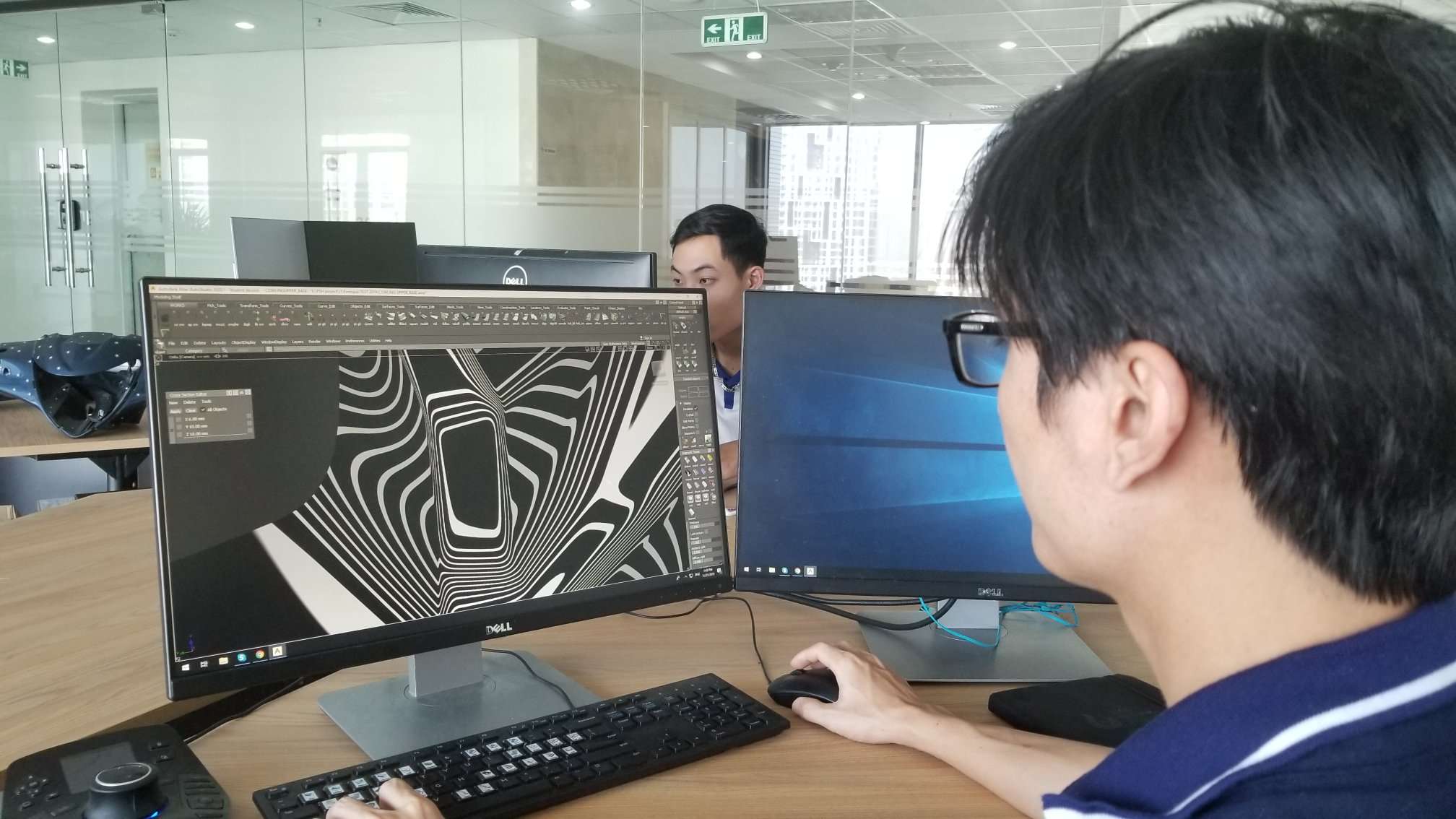
The studio in Hanoi. Zebra on the screen is what most of a working day looks like here.
In Germany we keep representative offices and local specialists, so European clients have someone to meet and someone who answers in their own language. Japan and the United States are planned next, for 2027 and 2028.
Why There Is No Client List
You will not find one on this site. Read that as information rather than as an omission.
Most of what we do goes out under someone else’s name. A measurement company delivers our models to its customer as its own work. A supplier shows surfaces to a carmaker with no third party in the room. That is the arrangement they want, and it is the one this company was built around.
The reason you cannot see who we work for is the same reason your competitors will not see you here.
What you can check is the work we own. Every image on this site is ours — our own concepts, our own aircraft, our own data. Nothing shown here belongs to a client, because none of it ever will.
What We Do Not Take On
We work on automotive bodies and interiors, and on the surfacing and engineering around them. Outside that: no machine or plant design, no electrical, harness or control systems, no screen and software interfaces, no general mechanical CAD.
We also do not take on correcting models built somewhere else. It costs more than starting again and it ends badly for everyone.
Saying this plainly saves both sides a month, and it is the reason a first conversation with us is short.
What You Are Actually Agreeing To
One part, one sketch, one zone — modelled at our cost, so you judge the result instead of the proposal.
You pay when the work is right, NET 30. Not before.
Every model is warranted for as long as you have it. If something turns out to be wrong — this month or in five years — we correct it at no charge.
Mutual NDA, back-to-back to your customer’s where required. No public cloud storage. Deletion on request, in writing.
What Happens After You Send It
A design engineer reads it — not a sales desk — and answers within 48 hours. If it is something we are good at, you get an approach and a question or two. If it is not, you get told that instead, which happens more often than you might expect.
There is no sequence of follow-up emails afterwards. If you do not reply, we assume you found someone better suited, and we leave it there.
If you cannot release data yet, a twenty-minute call does the same job. Describe what you are building and the standard you are held to, and we will tell you plainly which parts of it we are good at and which we are not.
Give Us the Awkward One
Send the part you would normally hesitate to outsource. That is the one worth testing us on, and the first one is at our cost.
Tuyển dụng · Hà Nội · quanh năm
PSH Design tuyển kỹ sư thiết kế ô tô
Sinh viên năm cuối thực tập và kỹ sư mới tốt nghiệp dưới 2 năm kinh nghiệm. Chuyên ngành Chế tạo máy hoặc Cơ khí. Đào tạo nội bộ bắt đầu từ mảng Reverse Engineering, trên dự án thật của các hãng ô tô Đức, Nhật, Anh.