CAS Design and Class A Modeling: The Complete Guide from Concept to Perfection
CAS design shapes a product. Class A modeling makes that shape manufacturable without losing it. CAS (Computer-Aided Styling) defines form, proportion and stance. Class A modeling rebuilds that form to G2 or G3 curvature continuity so reflections run unbroken across every joint and the data can go straight to tooling. PSH Design has run both disciplines in-house for 17+ years.
CAS and Class A: what actually separates them
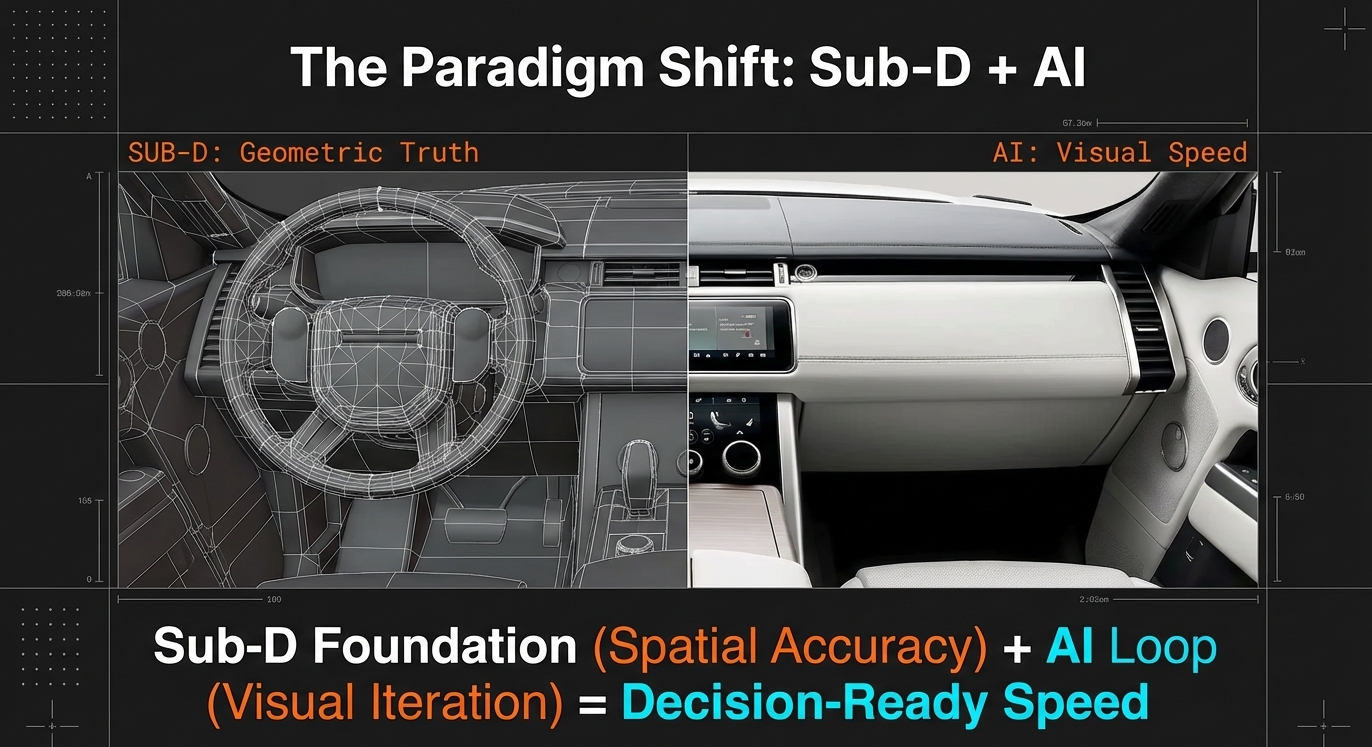
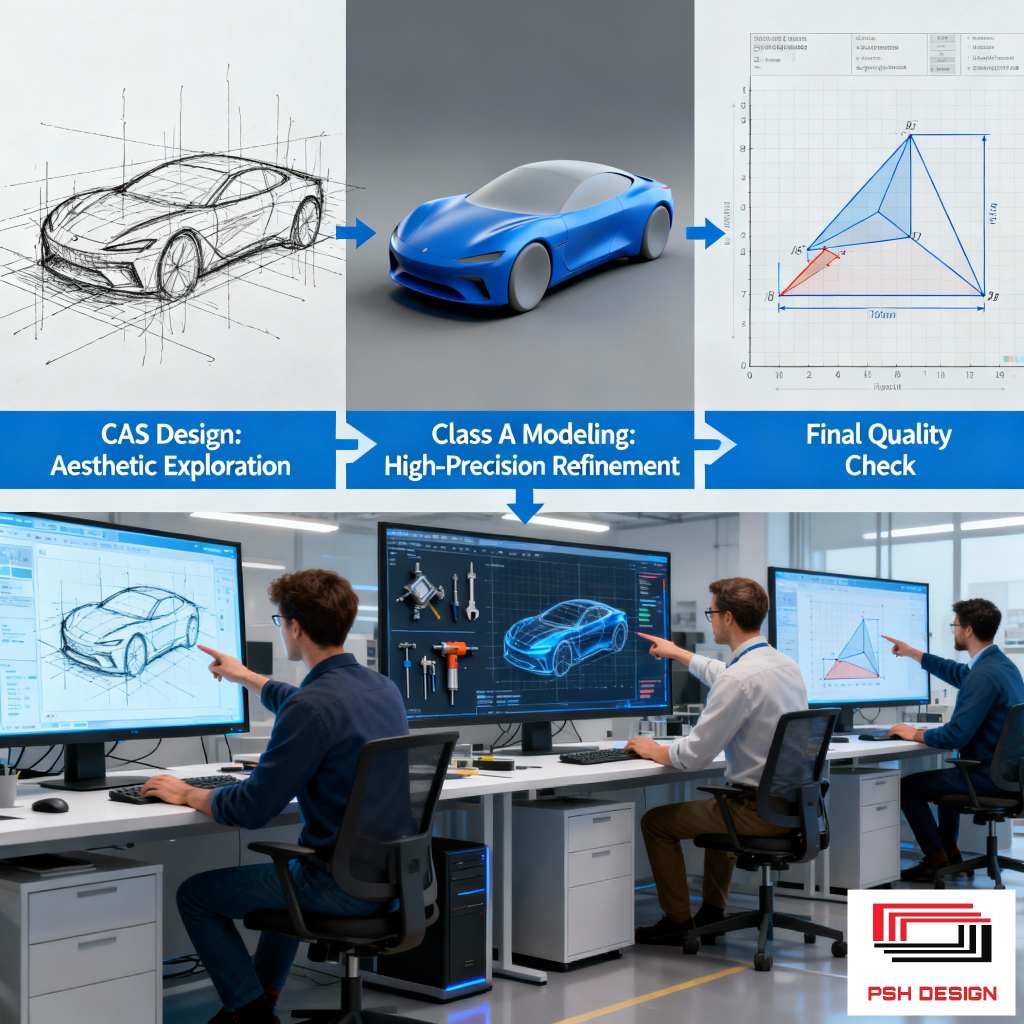
CAS (Computer-Aided Styling) is the shaping stage. It turns sketches, clay or intent into digital surfaces that can be judged — form, proportion, visual flow — and iterated quickly, before engineering commits to anything.
Class A modeling is the resolution stage. The surfaces are rebuilt to the highest standard of curvature continuity (G2 or G3), free of ripples, flat spots and highlight breaks, with patch layout an engineer can work with. It is where artistry stops being enough and craft discipline takes over, because the result has to survive an OEM surface audit and then a mold.
The practical difference: a CAS model answers “is this the right shape?” A Class A model answers “can this shape be built, ten thousand times, and still look like this?”
From CAS to Class A: a sequential journey
The relationship between CAS and Class A modeling is sequential yet interdependent.
- CAS modeling is the creative foundation — transforming ideas into 3D forms that define the design intent.
- Class A modeling is the refinement stage — where every reflection line and surface continuity reaches production quality.
A precise CAS foundation saves countless engineering hours. When Class A refinement begins, the model must already express the brand’s DNA, dimensional accuracy, and ready-to-manufacture geometry. Loose CAS data does not get “cleaned up” in Class A — it gets rebuilt, and that is where schedules are lost.
When Class A is worth it — and when it is not
Class A surfacing is essential for products where appearance defines value and performance:
- Automotive exteriors and interiors — body panels, dashboards, door trims, aftermarket kits
- Aerospace surfaces requiring aerodynamic precision and clean panel transitions
- Premium consumer electronics and luxury appliances
- Medical devices with hygienic and ergonomic requirements
It is not always the right spend. Projects with limited budgets, hidden structural components, or early-stage prototypes can go straight from CAS to CAD engineering without Class A refinement. Paying for Class A on a part nobody will ever see is a waste, and we will say so.
The real cost of surface imperfection
CAS and Class A modeling are usually discussed as technical topics. Their largest effect is financial. Behind every product launch sits a factor that quietly shapes margin, time-to-market and brand reputation: the quality of the surface data.
Small flaws — an irregular reflection line, a micro-level distortion at a patch boundary — trigger production delays, tooling revisions, failed audits and customer complaints.
- Correcting surface problems that originated in early digital design can take months and a significant budget, because by then the fix touches tooling that has already been cut.
- Poor finish results in lost opportunities, returned products or barriers to export, undermining the business case for the whole investment.
Experienced executives put it simply: superior surface quality is not about aesthetics or compliance. It is about de-risking a launch and keeping global partnerships open.
That is why the shift is toward integrated design teams able to hold quality and intent across every transition — CAS concept, Class A surfacing, production data — rather than handing the model between three suppliers and absorbing the loss at each border.
Software: Alias, ICEM Surf, CATIA, Rhino
| Criteria | Autodesk Alias | ICEM Surf | CATIA | Rhino + Grasshopper |
| Automotive | ★★★★★ | ★★★★★ | ★★★★ | ★★ |
| Aerospace | ★★★★ | ★★★★★ | ★★★★★ | ★★ |
| Medical devices | ★★★★ | ★★★★ | ★★★★★ | ★★★ |
| Premium consumer | ★★★★★ | ★★★★ | ★★★ | ★★★★ |
| Licence cost | High | Very high | Very high | Low |
| Learning curve | Steep | Medium | Very steep | Low |
Each platform has its strengths. Alias excels at creative surfacing and early exploration. ICEM Surf has defined explicit high-end surface quality for over three decades and remains the reference in many OEM studios. CATIA integrates design through to production data. Rhino offers flexible, cost-effective prototyping.
In practice the tool matters less than the hands. A Class A model built well in Rhino beats a bad one built in ICEM Surf — but at OEM acceptance level, Alias and ICEM Surf are what the audit expects, and that is what PSH Design works in.
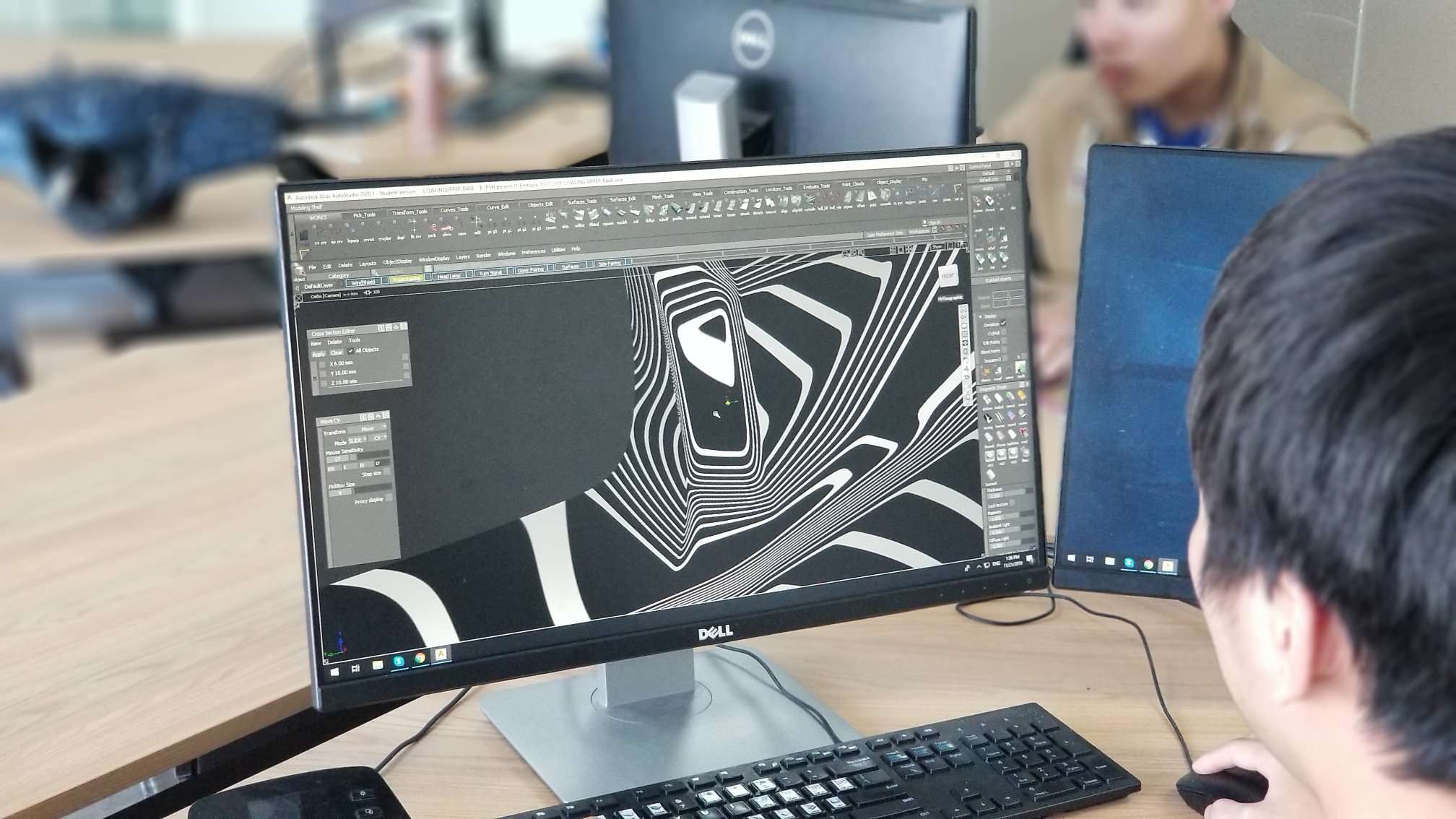
Alias in use at PSH Design, Hanoi. The Cross Section Editor is open over a zebra-shaded surface — the tool matters less than what it is being asked to prove.
Output data and file formats
CAS models are usually NURBS surfaces held in native formats: .wire (Alias), .CATPart (CATIA), .dc3 / .iges (ICEM Surf), plus polygonal .obj or .stl for visualisation.
Class A deliverables rely on:
- IGES (.igs, .iges) for NURBS geometry exchange — still the most widely accepted surface format.
- STEP (.stp, .step, AP242) for complex data integration in aerospace and automotive, where tolerances and annotation travel with the model.
- Native formats, which preserve construction history and metadata so the model stays editable for the next facelift instead of becoming a dead shell.
PSH Design delivers in whichever of these the client’s downstream process actually uses, including the native file.
What Class A looks like when it is met: four reference standards
Four widely recognised products show what the standard looks like in finished hardware.
Automotive — Mercedes-Benz S-Class
Body panels and interiors hold flawless reflection continuity from CAS through Class A refinement. Stand at a shallow angle to a door and the highlight runs the length of the car without a kink — that is the visible proof of G2/G3 work underneath.
Aerospace — Boeing 787 Dreamliner
Wing-to-body fairings, nacelle lips and winglet transitions are surfaced so curvature runs continuously across every joint, with no visible break where one panel meets the next. The same discipline produces the lean, deliberately crisp edges that read as engineered rather than moulded. In aerospace, surface quality is a geometry requirement before it is a styling one: the shape must be defined cleanly enough that aerodynamics, stress and tooling all work from one master.
Medical devices — MRI scanner shells and prosthetics
Human-centred forms with smooth, sanitary surfaces, no trapping corners, and a finish that carries clinical trust.
Premium consumer products — Apple iPhone and MacBook
Unibody aluminium and glass-to-metal transitions set the public benchmark for perceived quality. Much of what reads as “premium” is curvature continuity at the edges, held to a tolerance most industries never attempt.
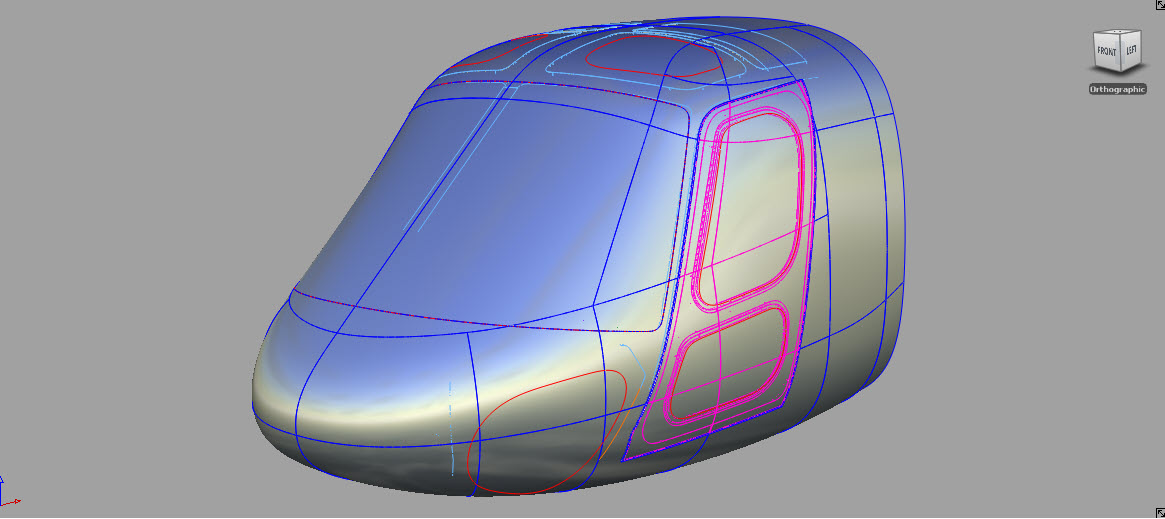
An in-house PSH Design canopy, patch-shaded. Aerospace is where surface discipline is tested hardest: the same data has to satisfy styling, aerodynamics and tooling.
The manufacturing link: turning perfection into reality
Even the best Class A design fails without precise CAM execution. CAM defines:
- Toolpath strategy and feed rates
- Surface finishing passes
- Material deformation simulation (CAE/FEA)
- Mold cooling optimisation, gate design, and polishing to SPI grade A-1 or A-2
Advanced CNC toolpaths, robotic polishing, zebra-stripe reflection analysis and automated optical inspection are what keep digital perfection intact through real production.
Carrying automotive Class A discipline into other industries
Transferring automotive Class A expertise into sectors that have never demanded it is one of the cheapest sources of product differentiation available.
- Medical devices: better ergonomic form, easier cleaning, higher patient comfort.
- Luxury consumer goods: visual distinction and higher perceived value from the same tooling budget.
- Drones: cleaner airflow over body and arms, and shapes that survive a moulding process without witness lines.
- Yacht interiors and exteriors: Class A hulls and joinery where elegance and engineering share the same surface.
Across all sectors, Class A quality changes not just how a product functions, but how it makes the user feel about the company that built it.
PSH Design: CAS to Class A under one roof
Founded in 2009 in Hanoi, PSH Design is among Asia’s few specialised studios running CAS concept development, reverse engineering and Class A surfacing inside one organisation.
What we do:
- CAS concept design: getting the concept right at the start, where changes are still cheap.
- Reverse engineering: recreating brand DNA from physical models or scan data while keeping compatibility with existing product lines.
- Class A modeling: automotive-grade surfaces for exterior panels, interiors and aftermarket kits.
Why this combination is rare. Class A surfacing is a craft trade. It is learned on the job inside OEM and Tier-1 studios over several years, not from a course, and the people who can hold G2/G3 continuity across a complete exterior to a top-tier OEM’s own acceptance criteria are few in any market — a shortage that has grown more acute as senior surfacing staff retire faster than studios train replacements. Studios that also run CAS concept work and reverse engineering in the same building are rarer still; most organisations do one of the three and subcontract the rest, and the model loses intent at every handover.
Global network, competitive value:
- European experts in Bavaria hold the work to OEM acceptance standards.
- Hanoi-based creative teams deliver agility and cost efficiency.
Together they provide world-class quality at optimised cost.
How we work:
- Input accepted as sketches, clay models, 2D drawings or 3D scan data.
- Scope tailored per project — full exterior, a single panel, or rescue work on someone else’s data.
- Free test project and 24-hour response, with full confidentiality.
PSH Design’s philosophy — “high focus on core competencies” — is a commitment to beauty, precision and partnership. 17+ years, one discipline, done properly.
Questions engineers ask about Class A
What is the difference between CAS and Class A modeling?
CAS defines the shape and is judged by eye. Class A rebuilds that shape to G2 or G3 curvature continuity with a clean patch layout so it can be manufactured without losing the design. CAS answers whether the form is right; Class A answers whether it can be built.
What does G2 or G3 continuity actually mean?
G0 means two surfaces touch. G1 means they share a tangent direction. G2 means they also share the same curvature at the joint, so a reflection crosses without a visible kink. G3 means the rate of change of curvature matches too, which is what removes the faint highlight flicker on large exterior panels.
Do I need Class A for every part?
No. Class A is for surfaces a customer will see, touch or photograph. Hidden structure, brackets and early prototypes can go from CAS straight to CAD engineering.
What do you need to start?
Any one of: a sketch or styling render, 2D drawings, a clay or physical model, 3D scan data (STL, OBJ or point cloud), or existing CAD that needs rescuing. We will tell you within 24 hours what is workable and what is not.
Which formats do you deliver?
IGES, STEP (including AP242) and the native file — Alias .wire, ICEM Surf, or CATPart — so your team can keep editing the model rather than receiving a dead surface set.
Can you work from scan data of an existing part?
Yes. That is our reverse engineering line: scan or measurement data in, Class-A-quality native CAD out, built to match the original intent rather than the noise in the mesh.
Conclusion
CAS design sets the vision. Class A modeling perfects it. But production excellence decides the outcome. Without robust CAM execution, mold optimisation and inspection discipline, even the best digital surfaces lose their integrity somewhere between the screen and the shipping crate.
The next decade of product differentiation lies in carrying automotive-grade surface standards into industries that have not yet demanded them — medical technology, drones, luxury marine.
With 17+ years of dedicated focus, PSH Design combines artistry, engineering and efficiency to help global partners reach world-class Class A standards.
Contact PSH Design: https://pshdesign.com/rfq-free-test-project/
—-
📚 FURTHER READING — KEY RESOURCES
1. Continuity G0, G1, G2, G3
Autodesk — Alias Help (2026). The reference definition of geometric continuity used in Class A work.
Link: help.autodesk.com — Continuity G0 G1 G2 G3
2. CATIA ICEM Surf — Advanced Surface Modelling
Dassault Systèmes. Product documentation for the explicit surface modeller used as the OEM reference for Class A.
Link: 3ds.com — CATIA ICEM Surf
3. What’s Next in Class A Surfacing
Dassault Systèmes, “Designing Impactful Innovation” podcast, ep. 21 (2024).
Link: 3ds.com — Ep21: What’s Next in Class A Surfacing
4. ISO 10303-242 — Managed model-based 3D engineering (STEP AP242)
International Organization for Standardization. The exchange standard behind STEP AP242 deliverables.
Link: iso.org — ISO 10303-242:2025
5. Metrology of Class A Surfaces in Automotive Manufacturing
Industrial Inspection & Analysis (IIA), technical article. How Class A surfaces are measured and verified after production.
Link: industrial-ia.com — Metrology of Class A Surfaces
6. SPI mold finish standards (A-1 to D-3)
American Precision Products. Grit and buffing definitions behind SPI A-1 / A-2 polish grades.
Link: injection-moldings.com — SPI Mold Finish Standards
PSH Design
17+ years of CAS, Class A Surfacing, CAD and Reverse Engineering for Automotive, Aerospace, Medical and Industrial, to OEM standard.
Concept Design & CAS · Class A Surfacing · CAD Engineering · Reverse Engineering
Work of this kind is easier to judge than to describe.