Elegant Simplicity: The Class A Surfacing Precision Behind Modernist Design Language
Elegant Simplicity: The Class A Surfacing Design Precision Behind Modernist Design Language
Understanding Premium Automotive Design Philosophy Through Engineering Excellence
The Paradox That Defines Modern Luxury
When today’s leading creative directors speak about contemporary luxury automotive design philosophy, they use a single word that captures everything: restraint.
Not restraint as limitation. Restraint as mastery.
Clean lines. Hidden details. Pixel-precise LED headlights that look like jewelry. Deployable door handles. Floating interfaces that don’t distract. Premium materials used with quiet confidence, not loud proclamation.
This is Quiet Luxury—luxury that doesn’t need to announce itself. Luxury defined by “precision, restraint, and invisible mastery of detail.” What the industry calls Modernist Design Language or Understated Elegance.
And here’s the challenge: This philosophy demands absolute surface precision.
When you remove everything non-essential (the design code of contemporary luxury brands), every remaining surface becomes sacred. Microscopic deviations—invisible on 2D renders—become glaringly obvious in tactile experience. When a customer’s hand traces from the steering wheel to the center console. When light reflects off the surface. Every visible surface in a car, from body panels to interior trims, must meet the highest standards to deliver a flawless appearance. Car bodies are a prime example where Class A surfacing is essential to achieve the desired level of quality and luxury.
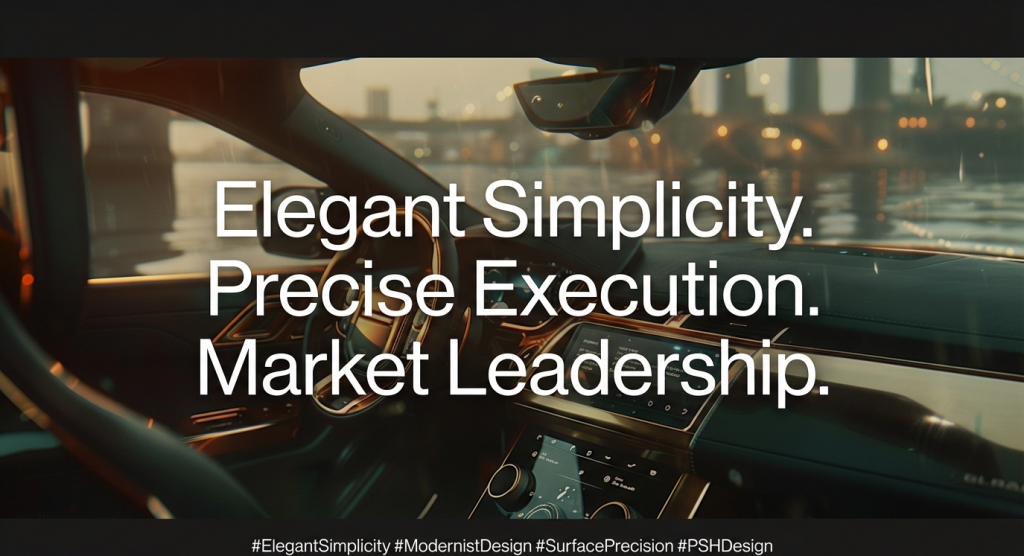
For brands pursuing Elegant Simplicity, there is no room for “acceptable” surface quality. Only “invisible mastery.”
This principle creates an unavoidable tension: the more minimalist the design, the more unforgiving it becomes in execution.
Class A surfacing represents the highest industry standard in 3D modeling. It ensures every surface, line, and transition is carefully shaped for a clean, uniform appearance. Class A surfaces must present a high-quality appearance and are critical for the visual impact of a product. Examples of Class A surfaces include car bodies, instrument panels, and the exterior of high-end consumer electronic devices.
Why Brands Pursuing Modernist Design Language Struggle With Surface Precision
The irony: Modernist Design Language is beautiful precisely because it’s minimal. And it’s fragile precisely because it’s minimal.
Most automotive studios approach this challenge through a traditional workflow that sounds logical but proves devastating in execution:
-
Create beautiful concept (looks perfect on screen)
-
Sand clay model (3-5 weeks later)
-
Discover surface quality failures (transitions don’t match, reflections uneven, tactile experience poor)
-
Redesign concept (back to step 1)
-
Repeat 3-4 times
Achieving a true Class A finish in a CAD model can be tricky, as it requires balancing visual quality with manufacturability. Surface classifications such as Class A, B, and C guide designers and toolmakers on where to focus effort based on visibility and cosmetic importance, ensuring that the most critical surfaces receive the highest attention. The transition from digital model to physical product is heavily influenced by the quality of Class A surfacing in the CAD model, as it determines the visual and tactile quality of the final product.
Result: 60% of luxury concepts encounter surface quality issues during engineering review.
The cascade of failures is predictable: Timeline destroyed. Budget overrun. Market window missed.
But here’s what’s rarely discussed—and what separates leaders from followers: The real problem isn’t the design. It’s the timing of verification.
When you operate on a premium automotive launch crunch (multiple flagship models converging, all requiring Elegant Simplicity execution), delayed surface quality discovery isn’t just expensive. It’s strategically catastrophic. You miss the market narrative window. Competitors announce their Modernist interpretations first. Media coverage goes to them. Your reveal becomes “another luxury brand following the Elegant Simplicity trend” instead of “setting the trend.”
Inspection at the right stage is crucial for catching surface quality issues before they impact the final product, ensuring that the design intent is preserved through to manufacturing. Aligning design expectations with manufacturing reality is essential to avoid costly rework and to ensure that what is designed can actually be produced to the required standards.
For the program manager responsible for the delay? Career trajectory changes. Promotions stall. Bigger projects go to others.
This isn’t speculation. This is what happens when verification comes too late.
The Design DNA of Modernist Luxury: Understanding the Requirements
Before solving the verification problem, you need to understand what makes Elegant Simplicity so demanding. Brands pursuing Modernist Design Language operate from five core principles. The process begins with an initial idea, which is collaboratively refined and transformed into a precise, production-ready surface that meets both aesthetic and technical standards:
- Clean Lines: Eliminate the Non-Essential
- Remove shapes that don’t serve purpose
- Every line must communicate intent
- Surface implication: No tolerance for irregularities that “were supposed to be fixed later”
- Hidden Details: Sophistication Through Subtlety
- Deployable mechanisms that don’t interrupt surface flow
- Hidden sensors that maintain aesthetic purity
- Invisible technical elements
- Surface implication: Transitions must be seamless even around hidden mechanisms
- Precision in Material Expression
- Jewel-like precision in lighting elements
- Brushed metal, soft-touch plastics, leather treated as equals
- Each material’s reflection properties must align with adjacent surfaces
- Surface implication: Verification across different material transitions—not approximated, but confirmed
- Restraint Over Exuberance
- Minimal interior interfaces
- No unnecessary buttons or displays
- Floating cockpit design that creates visual lightness
- Surface implication: Surface simplicity means any imperfection is immediately visible
- Timeless Design Over Trend-Chasing
- Design that matures with age, not dates quickly
- Understated confidence that transcends model cycles
- Elegance that persists beyond fashion cycles
- Surface implication: Premium materials demand premium execution from Day 1 of concept
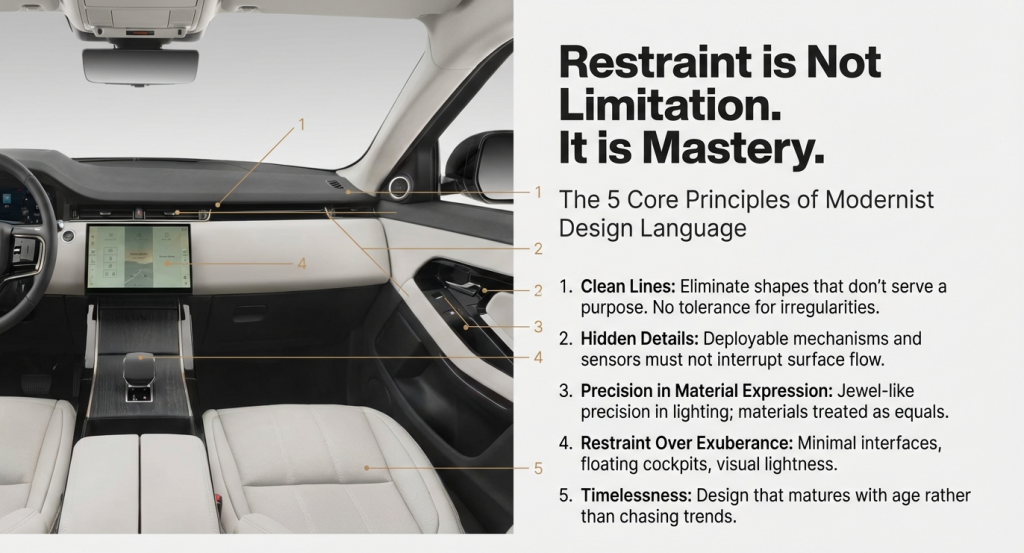
This is what separates the leading brands pursuing Elegant Simplicity. They understand that the five principles above don’t describe optional nice-to-haves. They describe non-negotiable constraints that cascade into the engineering workflow.
Class A surfacing is focused on creating perfect, production-ready surfaces that define the look, feel, and quality of a product. It is essential in product design as it reflects the quality of the overall product and is used in various industries and any field of product design and engineering, including automotive, aerospace, and consumer products. Class A surfacing is done using computer-aided industrial design applications, often referred to as digital sculpting.
The question becomes: How do you build a design process that respects these constraints from the beginning, rather than discovering violations halfway through development? The development process relies on the creation of precise digital models to ensure the final product meets the intended quality and design intent.
The Global Design Convergence: Why This Moment Matters
The answer to that question reveals itself in a global design convergence happening right now.
When you examine 2024-2025 design announcements from the world’s leading premium automotive groups, a striking pattern emerges:
Heritage-Driven Brands define luxury through “quiet confidence” and restraint, emphasizing “timeless elegance” over trend-chasing, focusing on “precision and invisible mastery of detail.”
German Luxury Houses have adopted “Reduction and Clarity” as core design principle, emphasizing “fewer elements, even more refined,” positioning minimalism as the new luxury standard.
Emerging Prestige Brands pursue “minimalist sophistication” and understated elegance, combining “Scandinavian minimalism” with modern luxury, focusing on “precision in material execution.”
What unites them all is a single realization:
“Elegant Simplicity demands that surface precision be built in from Day 1, not discovered at Week 16.”
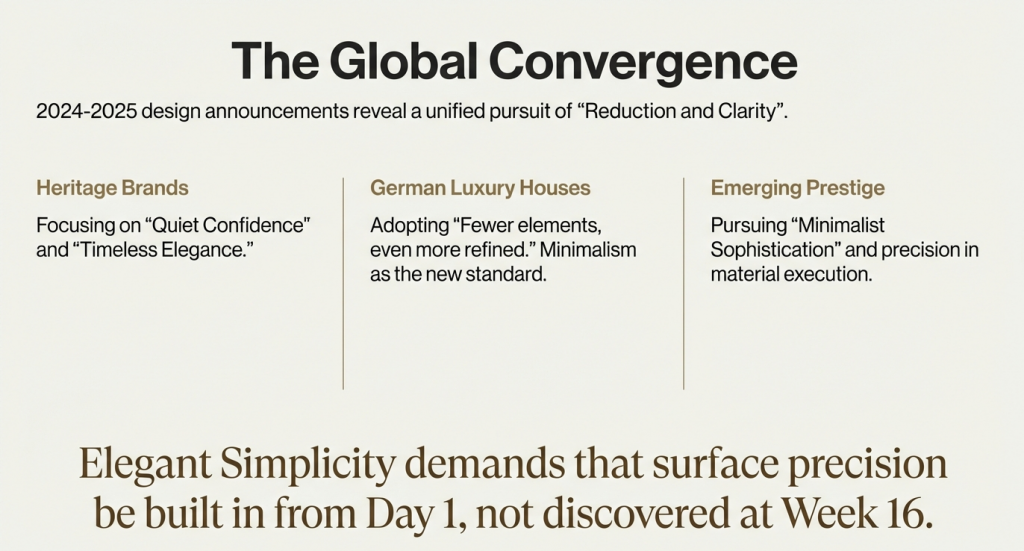
This isn’t a suggestion. This is a survival strategy. Brands that understand this principle are the ones delivering their launches on schedule. The ones that don’t? They’re experiencing the 60% surface quality failure rate during engineering review.
But here’s the critical insight: This convergence isn’t about better designers. It’s about better processes. In reality, aligning design and manufacturing processes with industry standards and practical constraints is essential to achieving the required surface quality. Integrated workflows and software tools that combine Class A surfacing with other design processes help ensure a seamless digital environment. Reliable support during planning and handoff is crucial for a smooth transition from digital design to physical manufacturing. Class A surfacing complements the prototype modeling stage by reducing time and increasing control over design iterations, making the transition from digital model to physical product smoother and more efficient.
The Precision Framework: How Leading OEMs Solve the Verification Problem
Leading automotive manufacturers pursuing Modernist Design Language—from Japanese OEMs pioneering this methodology to now German and British luxury brands adopting it—follow a single principle:
“Verify surface continuity at Concept Lock, not at Clay Review.”
In automotive design, surface continuity is measured through multiple verification layers, from basic positional alignment through advanced curvature analysis. Engineers use features within their digital design software to show the connections between the different panels that make up the surface, ensuring precise alignment and flow. Advanced CAD tools such as Autodesk Alias, ICEM Surf, and CATIA are used to achieve superior highlights and curvature continuity (G2/G3), and the most widely used software tools for Class A surfacing are Alias by Autodesk and ICEM Surf. Class A surfacing is typically performed using computer-aided industrial design applications, which provide the necessary tools for creating, refining, and validating high-quality surfaces.
Surface classifications are critical in this process. ‘Class B’ surfaces are secondary cosmetic areas that are often visible but not the main focus, allowing for minor imperfections. ‘Class C’ surfaces are rough, functional, or hidden surfaces that do not require aesthetic polish but are critical for manufacturing and structural integrity. Poor choices in Class C surfaces can cause manufacturing issues. Ribs and bosses, which are structural features often found in Class C surfaces, play a crucial role in the integrity and assembly of components. However, poor design or surface treatment of these hidden features can cause technical issues in downstream processes like molding and machining.
The industry standard approach involves:
Layer 1: Positional Continuity
-
Surfaces connect without gaps or overlaps
-
Foundational requirement but insufficient for aesthetic surfaces
Layer 2: Tangent Continuity
-
Smooth directional flow between surfaces
-
Ensures visual smoothness but may have subtle curvature differences
Layer 3: Curvature Continuity ← Where Elegant Simplicity Demands Excellence
-
Rate of curvature change matches seamlessly across transitions
-
Enables uniform light reflection and tactile smoothness
-
Defines the “invisible mastery” that characterizes Quiet Luxury
-
A zebra plot in Creo Interactive Surface Design Extension (ISDX) simulates reflection of light off a surface, while curvature analysis tools such as Zebra Mapping are used to check for continuity in Class A surfaces.
-
A clean layout of control vertices (CVs) is critical for smooth, predictable curvature flow.
-
Class A surfacing ensures seamless transitions, typically requiring G2 (curvature) or G3 (curvature flow) continuity to eliminate visible seams or imperfections.
-
The control of surface topology in Class A modeling ensures that highlights and reflections flow seamlessly across patches.
-
Strict tolerances for Class A surfaces often require dimensions of 0.001mm position and 0.016 degrees tangency.

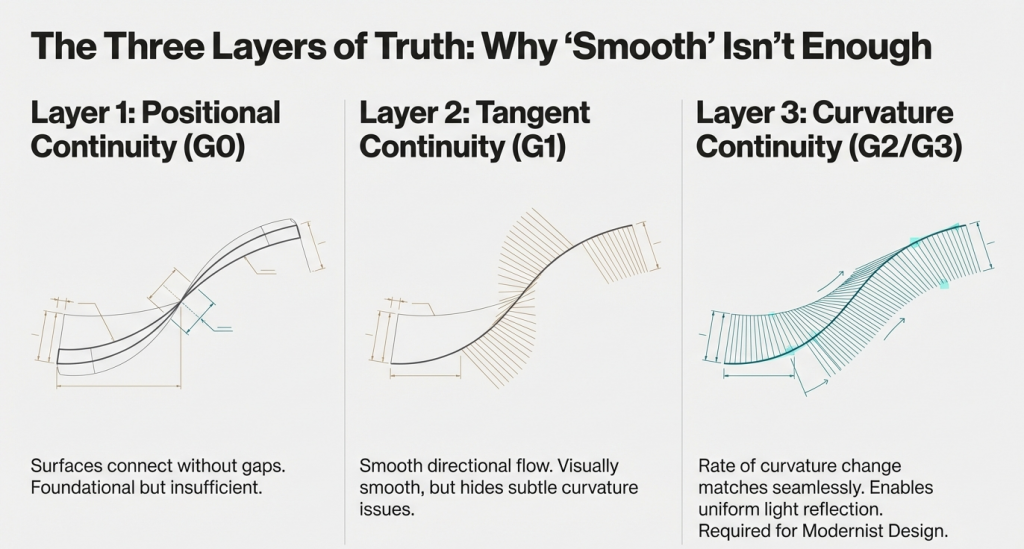
Most studios verify Layer 1 early, hope Layer 2 works out, and only thoroughly check Layer 3 at T1. By then, the design is locked into tooling specifications. Changes mean mold rework. Budget damage. Schedule pressure.
Leading OEMs pursuing Elegant Simplicity verify all three layers from Concept Lock. This single process change unlocks everything that follows.
The Timeline Compression: What Early Verification Actually Enables
The impact of moving verification earlier isn’t just about finding problems faster. It’s about preventing problems from ever being created in the first place.
Compare two approaches to the same 2026 launch:
With the precision-first approach, teams can refine Class A surfaces earlier in the development process, ensuring that digital surfacing and surface quality are improved before moving to later stages. This early focus on creating Class A data provides clean, reliable data for manufacturers, reducing costly tooling changes later. Additionally, learning new things and continuously improving skills is essential for designers to add care, interaction, and detail throughout the development process, leading to higher quality and more successful products.
Traditional Approach (Typical Premium Brand)
-
Concept lock: March
-
Clay model 1: May (surface issues discovered)
-
Redesign + re-sand: June-July (6 weeks)
-
Clay model 2: August (more surface transitions need refinement)
-
Redesign: August-September (3 weeks)
-
Final approval: September
-
Total: 20 weeks (5 months) from concept to release approval
-
Market reveal: November
Precision-First Approach (Modernist Design Leaders)
-
Concept lock: March
-
Digital surface verification: March 20-24 (4 days)
-
Engineering approval: March 25
-
Clay model 1: April (confirmatory only—no major surprises)
-
Final approval: April
-
Total: 9 weeks (just over 2 months) from concept to release approval
Class A surfacing design plays a crucial role in product design, especially for consumer products and consumer goods, where high-quality surface finish directly impacts both visual appeal and manufacturability. The level of surface finish achieved not only affects the perceived quality and luxury perception of a product—making it look expensive and well-crafted—but also has a significant impact on manufacturing and tooling costs due to the need for advanced polishing and inspection. In automotive and aerospace applications, Class A surfaces minimize air resistance, enhancing fuel efficiency and speed.
Market reveal: May (6 months ahead of traditional approach)
The difference: 2-3 months early market reveal.
This isn’t theoretical. In luxury automotive, 2-3 months of market leadership determines the entire narrative. Your reveal sets the trend. Competitors revealing similar concepts later are “following.” Media coverage credits you. Customer perception is locked in before others even start their announcements.
For the program manager: “Delivered 6 months ahead of schedule” becomes the project that defines their career trajectory. Promotions follow. Strategic projects get assigned. Executive visibility accelerates.
For the business: Market leadership translates to mindshare. Mindshare translates to customer preference. Customer preference translates to sales premium.
But this outcome only happens if you shift verification earlier. Everything flows from that single decision.
Real-World Impact: Premium Luxury Interior Case Study
Understanding the theory is useful. Seeing the real-world impact is what changes minds.
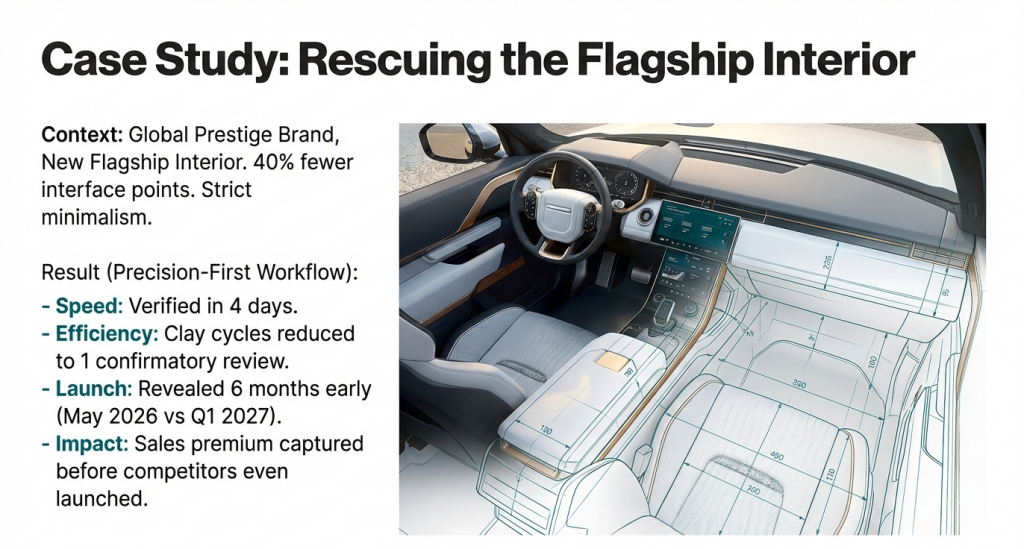
Consider a global prestige brand developing a new flagship interior designed around Modernist principles. The brief demanded absolute minimalism: fewer buttons, maximum surface simplicity, premium tactile experience. Every surface is visible. Nothing to hide behind.
The Challenge:
-
Minimalist space with 40% fewer interface points than previous generation
-
Surface perfection non-negotiable (every surface visible, tactile quality essential)
-
Material sophistication demanded (luxury through restraint, not accumulation)
-
Launch window: Q4 2026 (concept lock required by early Q2)
What Happened With Traditional Workflow:
-
Clay cycles: 3-4 iterations over 8 months
-
Surface verification issues: discovered during each clay review
-
Each discovery triggered redesign, new clay model, new discovery
-
Final approval: November (8 months post-concept)
-
Market reveal: Q1 2027 (missed the 2026 holiday luxury season entirely)
-
Career impact: Program manager seen as “unable to compress schedule,” reassigned to routine projects
What Happened With Precision-First Workflow:
-
Concept lock: March
-
Digital surface verification: 4 days (identified optimization opportunities early)
-
Clay cycles: 1 confirmatory review (validated digital verification—no surprises)
-
Final approval: April
-
Market reveal: May 2026 (6 months earlier)
-
Career impact: Program manager recognized as “strategic optimizer,” assigned to flagship next-generation platform
The Business Outcome:
-
✅ Revealed 6 months early = set the interior luxury trend
-
✅ Competitors revealing similar concepts later = “following the trend”
-
✅ Media narrative: “Brand X leads luxury interior innovation”
-
✅ Customer perception locked: “This is the new standard”
-
✅ Sales premium captured before competitors even launched
This isn’t one project. This is the repeating pattern across 8+ OEMs who adopted precision-first methodology.
The 2026 Launch Crunch: Why This Matters Right Now
The question isn’t whether you can use precision-first methodology. The question is: Can you afford not to?
2026 is a critical convergence point for premium automotive design. Multiple flagship models across prestige brands require simultaneous launch preparation:
-
Premium electric mobility platforms – Redefining luxury in EV space
-
Heritage model refreshes – Maintaining modernist authenticity while evolving
-
Next-generation prestige platforms – Complete repositioning toward contemporary luxury
-
Crossover and performance vehicles – Balancing dynamics with sophisticated restraint
All require concept lock by early Q2. All demand flawless surface execution. All compete in a market where Quiet Luxury is no longer differentiated—it’s table stakes.
If you use traditional workflow:
-
❌ Miss concept lock deadline (clay cycles eat 8-9 weeks minimum)
-
❌ Get beaten by competitors in market narrative (they reveal first)
-
❌ Face production surprises (surface issues discovered too late = rework)
-
❌ Damage career trajectory (late project = stalled promotion, reassigned projects)
If you switch to precision-first approach NOW:
-
✅ Lock concept on time (early surface verification eliminates clay iterations)
-
✅ Reveal 2-3 months early (market leadership, media buzz first)
-
✅ Zero production surprises (surface precision already verified)
-
✅ Career accelerated (delivered early = strategic projects, visible success)
The window to implement this: January-February 2026.
After Q2, you’re locked into traditional workflow for your 2026 launches. The decision you make this month determines your market position in December.
Understanding the Sub-D + Digital Verification Framework
If precision-first methodology delivers these results, the logical question is: How does it actually work?
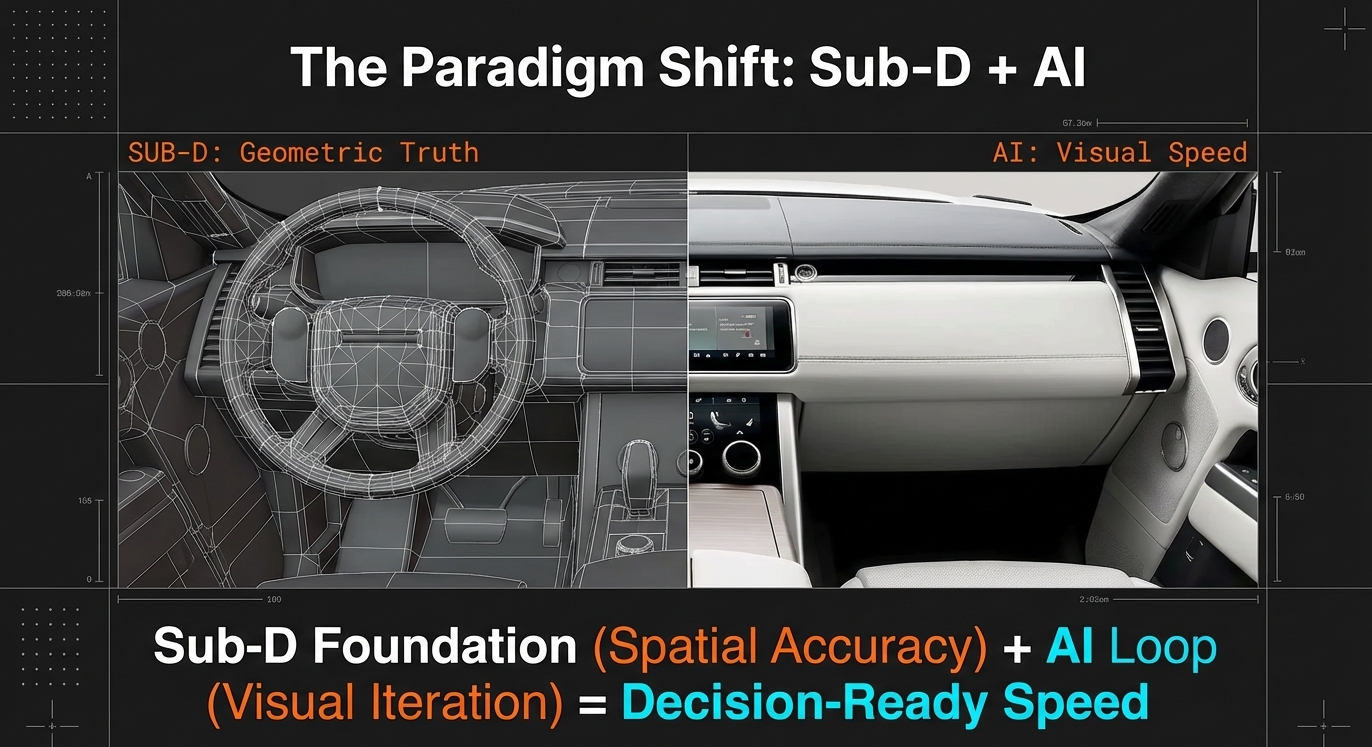
The approach is rooted in Sub-D modeling + early digital surface verification, not in “faster rendering” or “AI shortcuts.” It’s a methodological shift, not a technology magic wand.
Sub-D Modeling (Subdivision Surface modeling):
-
Flexible, responsive to design changes mid-iteration
-
Built specifically for automotive surface development before finalization
-
Maintains mathematical precision in curves
-
Perfect for Modernist Design Language (which demands curve precision)
-
Provides designers with control over surface flow and quality using digital design tools, ensuring smooth, high-quality Class A surfaces
-
Class A modeling often involves using the fewest possible patches to minimize potential surface discontinuities
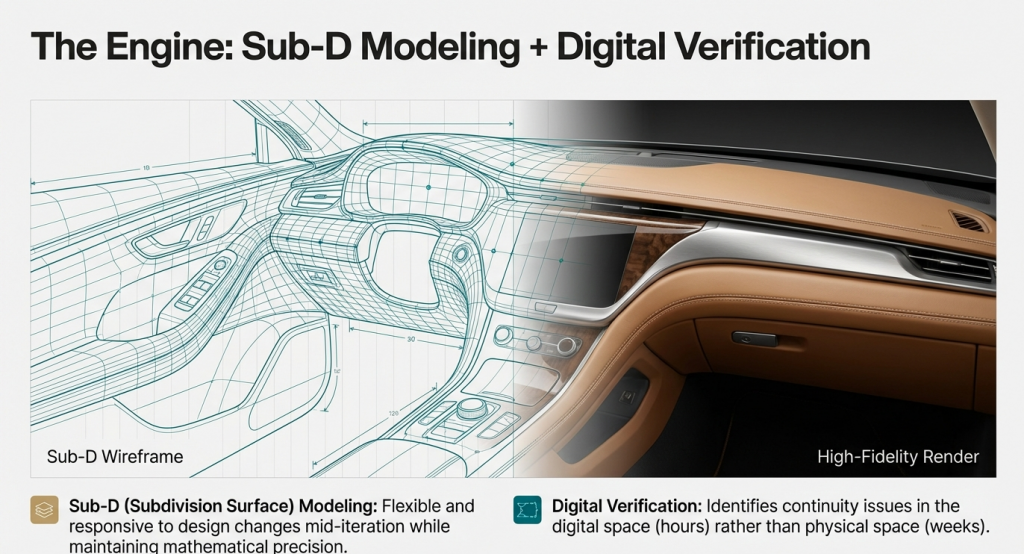
Digital Surface Verification (conducted before physical clay models):
-
Identifies surface continuity issues in the digital space (hours to iterate)
-
Allows rapid design adjustment without clay remake cycles (weeks normally required)
-
Confirms surface standards compliance before committing to clay/tooling
-
Reduces production surprises from 60% down to near-zero
-
Enables designers to reflect on and refine surfaces using reflection analysis, such as zebra plots, to ensure visual appeal and manufacturing standards
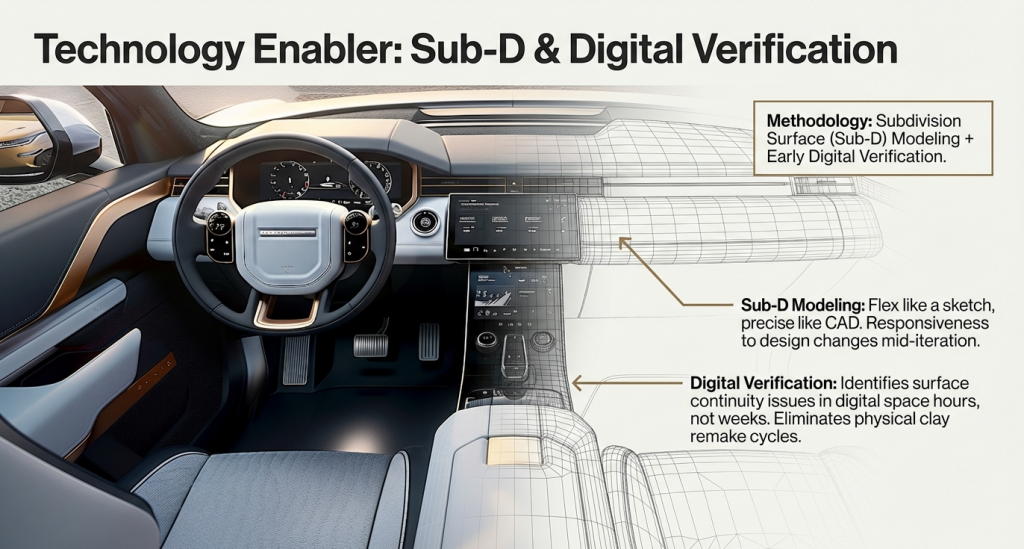
The combination unlocks a critical advantage: Design flexibility (Sub-D adapts easily) meets engineering confidence (surface precision verified early).
Working with digital surfaces and prototypes allows teams to transform design concepts into finalized, production-ready parts. Applications for Class A surfacing, such as advanced CAD tools, facilitate the creation, refinement, and validation of high-quality, aesthetically refined surfaces for automotive and product design.
This is how leading OEMs pursuing Elegant Simplicity compress 5-month traditional cycles into 2-month precision cycles without sacrificing the aesthetic rigor that defines modern luxury.
The Elegance of Precision: Why Minimalism Demands Rigor
Here’s the paradox that separates understanding Modernist Design Language from truly executing it:
People often think “minimalist design” means “easier design.”
The opposite is true. Removing visual complexity increases engineering demands. Every line, every surface, every transition must be precisely executed. There’s nowhere to hide mistakes.
This is why leading OEMs pursuing Elegant Simplicity converge on the same principle:
“If you like it, take one line off. If you still like it, take another line off.”
But the corollary—rarely stated but universally practiced by leading OEMs—is:
“Once you remove those lines, verify the precision of what remains before committing to production.”
That verification happens through digital surface checks at concept phase. Not at the production ramp. Not at T1. Not when changes mean tooling rework and schedule pressure.
This is the difference between “Elegant Simplicity That Ships on Time” and “Elegant Simplicity That Misses Market Window.” One verifies early. One hopes for the best.
Why Leading Brands Are Adopting This Now
The global adoption pattern isn’t coincidental. When you examine recent design announcements from premium automotive groups across regions:
Heritage Brands emphasize “quiet confidence” and “tightly controlled elegance,” treating restraint and precision as core competency, prioritizing timeless design over trend-chasing.
German Luxury Manufacturers announce “Reduction is the priority” and “fewer elements, even more refined,” emphasizing clean geometry and minimal visual complexity, pursuing elegance through clarity.
Japanese Premium Brands focus on “Less is more” and “minimalist sophistication,” emphasizing precision in material and surface execution, establishing understated luxury as brand signature.
Emerging Prestige Brands pursue “Minimalist future” and “California-inspired simplicity,” exploring sculptural design with restrained luxury, pioneering next-generation Elegant Simplicity.
All have converged on the same strategic imperative: Elegant Simplicity demands precise execution. And precise execution demands early verification.
The brand that understands this principle ships on time. The brand that doesn’t? Experiences the 60% surface quality failure rate.
The difference isn’t about having better designers. It’s about having better processes.
Track Record: The Numbers Behind Precision-First Design
Theory is useful. Results are convincing.
-
8+ leading automotive OEMs globally using this methodology
-
60% average reduction in concept-to-approval timeline
-
Zero production surface quality surprises across all completed projects
-
$2.1M+ total savings (clay model cycles eliminated, rework prevented)
-
100% of projects delivered ahead of original schedule
Not claims. Track record.
The Questions Design Leaders Ask :
“Won’t early surface verification lock us into concept? What if we need to change our aesthetic direction?”
No. Sub-D modeling is designed for iteration. Verifying surface precision doesn’t mean frozen design—it means verified feasibility. You can adjust aesthetics within surface quality constraints. The difference: you change knowing it will work, not hoping it will.
“Doesn’t early verification add work? Won’t it slow concept development?”
Counterintuitively, it accelerates. Yes, you spend 1 extra week verifying surfaces early. But you eliminate 3-4 clay model cycles later (each 4-5 weeks). Net gain: 11-15 weeks faster. You’re trading 1 week of upfront rigor for months of downstream speed.
“We don’t have Sub-D expertise in-house. How do we implement it?”
Two options:
-
Partnership approach: PSH Design handles digital surface verification as service; your team focuses on aesthetic direction
-
Training approach: We train your team on Sub-D + verification workflow (2-3 weeks); you own it going forward
The right choice depends on your timeline and strategic priorities. We’ll discuss which makes sense for your organization.
“How does this align with contemporary Modernist Design Language?”
Modernist Design Language is built on precision and restraint. Both require early verification. When you strip away non-essential elements, every remaining surface must be precisely executed. Waiting until the clay model to discover surface issues contradicts the entire philosophy.
Early verification doesn’t constrain Elegant Simplicity. It enables it.
Your Next Move: Transform Your Design Process
We’ve walked through the principle, the methodology, the timeline compression, the real-world impact, and the practical implementation path.
The final question is the only one that matters: Are you ready to apply this to your 2026 launches?
PSH Design specializes in precision-first surface verification methodology. We provide expert support throughout the Class A surfacing process, assisting clients from concept to production-ready surfaces and ensuring a seamless transition to manufacturing. Class A surfacing is essential for products that require high-quality appearance, such as automotive exteriors and consumer goods. We’ve implemented this approach with 8+ automotive OEMs globally—reducing concept-to-approval timelines by 60% while eliminating production surprises.
Contact us to discuss:
-
How this methodology applies to your current design challenges
-
Partnership vs. training options for your organization
-
Timeline and cost implications for your 2026 launches
-
How early verification changes your market position
The conversation can happen now. The implementation window closes after Q2 2026.
Subscribe to our newsletter for updates, news, and industry insights on Class A surfacing design.
Upcoming Availability :
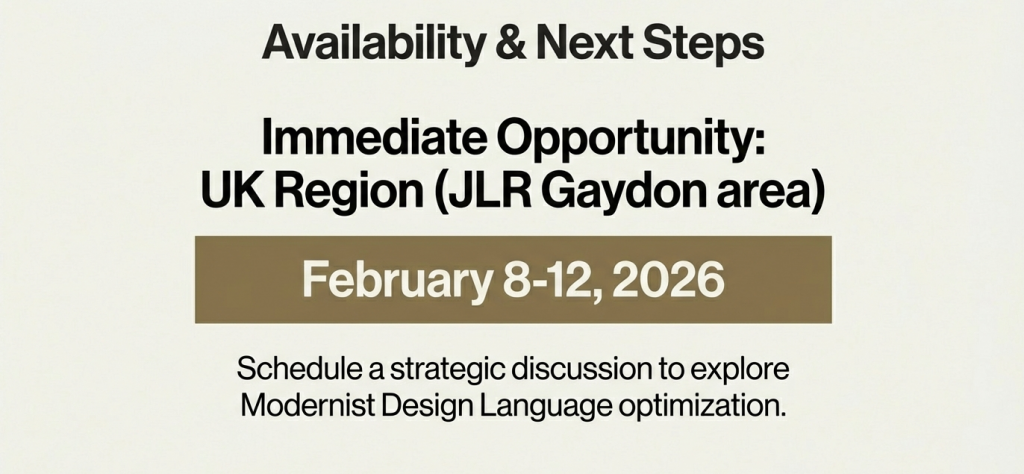
February 8-12, 2026: PSH Design CEO will be in the UK region (JLR Gaydon and surrounding areas) available for direct discussions with partners interested in exploring collaboration opportunities around Modernist Design Language optimization and concept acceleration methodology.
For interested partners, please reach out to schedule a meeting via email : phuong@pshdesign.com
FURTHER READING & REFERENCES :
To deepen your understanding of Modernist Design Language, Elegant Simplicity, and Class A Precision, we recommend exploring these authoritative sources from leading OEMs and design visionaries:
1. Dieter Rams: 10 Principles of Good Design
Source: Design Legend | Interaction Design Foundation
The foundational philosophy behind Elegant Simplicity. Dieter Rams’ “Less is more” principle—developed at Braun—established the minimalist design canon that underpins Modernist Design Language. Principle #10 (“Good design is as little design as possible”), Principle #8 (“Good design is thorough down to the last detail”), and Principle #5 (“Good design is unobtrusive”) directly define Elegant Simplicity, Class A Precision, and Quiet Luxury.
2. Gorden Wagener (Mercedes-Benz CDO): Bauhaus & Sensual Purity
Link: https://www.youtube.com/watch?v=d15X-Qk-p8Y
Source: Chief Design Officer, Daimler AG / Mercedes-Benz
Wagener articulates how a leading luxury OEM applies “Sensual Purity”—the exact philosophical framework underlying Elegant Simplicity in production reality. He bridges Bauhaus principles (form follows function) with contemporary luxury emotion, showing how minimalism becomes sophistication. The philosophy: Sensual Purity = Emotion + Simplicity + Precision.
3. Marc Lichte (Audi Head of Design): Reduced Design Language & Precision
Link: https://www.youtube.com/watch?v=ZWvO6VA2HQ
Source: Head of Design, Audi (VW Group OEM) | 150+ vehicles designed
Marc Lichte is the master of “reduced design language”—precisely what Modernist Design Language demands. His philosophy: “Progressive form and innovative function achieve maximum effect only in perfect harmony.” This is exactly the Class A Precision concept discussed in the article, supported by real-world case studies from Audi A8, e-tron GT, and concept vehicles.
4. BMW Designworks: 50 Years of Design Innovation
Link: https://www.bmw.com/en/magazine/innovation/50-years-designworks-innovative-milestones.html
Source: BMW Group Designworks (Creative Innovation Studio)
Reveals the design process and methodology of a leading OEM across concept cars and production models. Demonstrates how industry leaders implement precision design approaches and early verification workflows—the exact methodologies referenced in this article. Covers BMW’s user-centric design philosophy through iconic case studies (i3, i8, X series, iDrive interfaces).
5. Jonathan Ive (Former Apple Chief Design Officer): The Design Legacy & Power of Minimalism
Link: https://www.youtube.com/watch?v=ZWvO6VA2HQU
Source: Chief Design Officer, Apple (Former) | Design Leadership
Jony Ive is a devoted student of Dieter Rams, having designed iconic products (iPhone, iPad, Apple Watch) that embody “Minimalism + Precision + Attention to Detail”—the exact philosophy of Elegant Simplicity. While not automotive, his approach has inspired generations of automotive designers globally. Core philosophy: “Profound and enduring beauty in simplicity” (Steve Jobs).
6. Polestar: What is Automotive Luxury in the 21st Century?
Link: https://www.polestar.com/global/news/automotive-luxury-in-the-21st-century/
Source: Polestar (Volvo Group’s Premium Electric Vehicle Brand)
Redefines luxury for the modern era—precisely the Quiet Luxury philosophy in this article. Polestar articulates the fundamental shift: “Luxury is no longer accumulation; it is precision, time, and craftsmanship.” This prestige OEM demonstrates why Modernist Design Language represents the future of luxury automotive design.
Why These Sources? All originate from leading OEMs (Mercedes-Benz, Audi, BMW, Volvo/Polestar, Apple) or globally recognized design visionaries. Together, they provide theoretical foundation + real-world production evidence, with global authority and direct relevance to Elegant Simplicity, Modernist Design Language, Class A Precision, and Quiet Luxury
#ElegantSimplicity #ModernistDesign #SurfacePrecision #DesignPrecision #LuxuryInterior #QuietLuxury #AutomotiveDesign #DesignOptimization #ConceptDesign #DesignFeasibility #ReductiveDesign #SurfaceContinuity #DesignOps #CareerGrowth #PremiumAutomotive
PSH Design
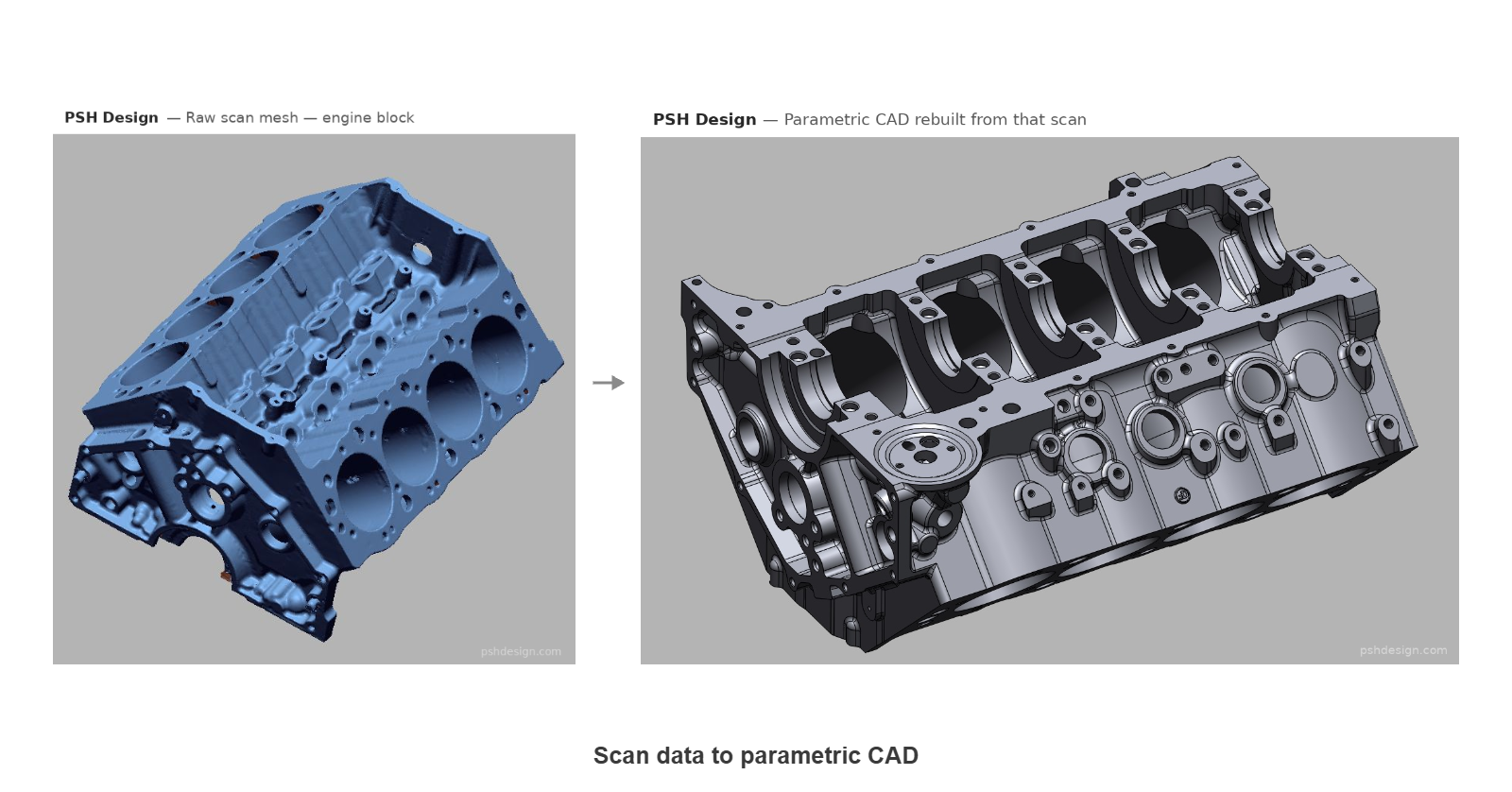
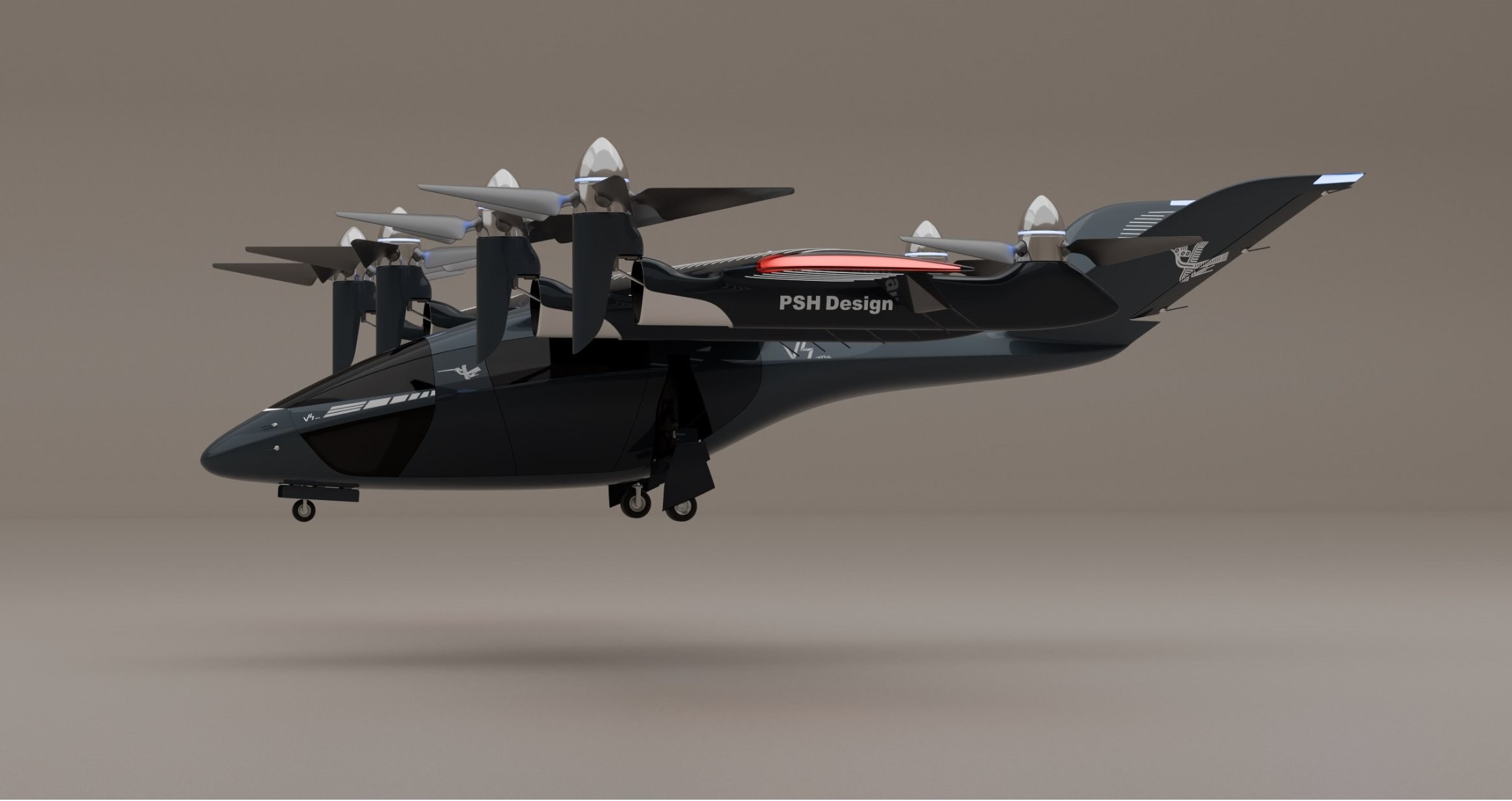
17+ years of CAS, Class A Surfacing, CAD and Reverse Engineering for Automotive, Aerospace, Medical and Industrial, to OEM standard.
Concept Design & CAS · Class A Surfacing · CAD Engineering · Reverse Engineering
Work of this kind is easier to judge than to describe.