In-Depth Comparison: CATIA, NX, Creo for CAD Engineering 2025
In today’s fiercely competitive manufacturing world, the ability to quickly translate innovative design concepts into high-quality products is a decisive advantage. Computer-Aided Design (CAD) engineering stands at the heart of this transformation, powering industries such as automotive, aerospace, medical devices, and industrial equipment with precision and speed. Choosing the most suitable CAD platform is not merely a technical decision but a strategic imperative that shapes the efficiency, creativity, and market readiness of your designs. This article explores the leading CAD platforms, their unique strengths, investment considerations, and how expert partnerships—like PSH Design—can unlock their full potential to drive innovation and excellence in your product development journey
1. The Strategic Importance of CAD Engineering for Innovative Design
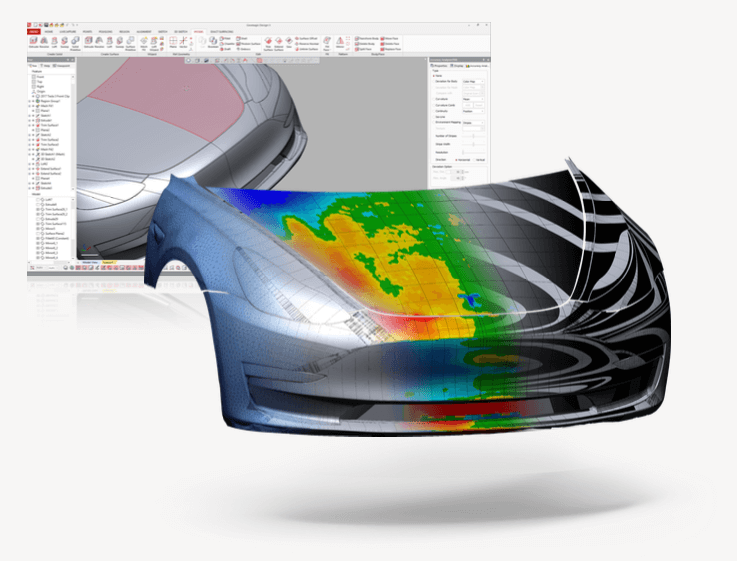
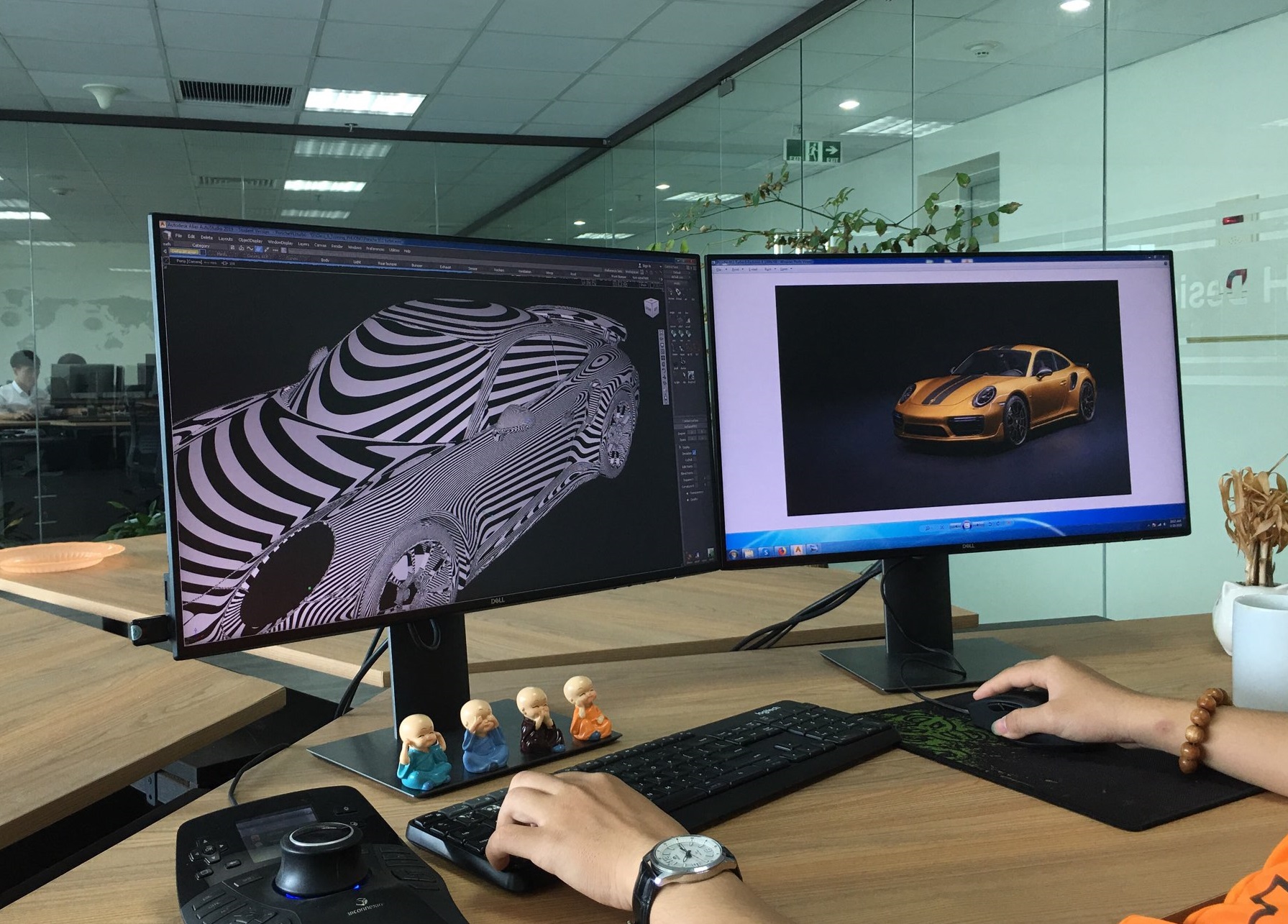
In today’s advanced manufacturing landscape—including automotive, aerospace, medical devices, and industrial equipment—CAD engineering is the cornerstone of transforming groundbreaking design ideas into reality efficiently and accurately. Selecting the right CAD software accelerates concept design, enables mastery in Class A surfacing, and facilitates precise reverse engineering while streamlining workflows and enhancing product quality. Choosing the ideal CAD platform is a strategic decision that impacts how quickly and effectively your ideas reach market readiness.
2. Core CAD Platforms: CATIA, Siemens NX, and PTC Creo
The three leading CAD solutions essential across industries include:
- CATIA (Dassault Systèmes): The gold standard for automotive and aerospace companies requiring flawless Class A surfacing.
- Siemens NX: Offers powerful, integrated multidisciplinary design capabilities, connecting mechanical, electrical, and electronics engineering with collaborative Product Lifecycle Management (PLM).
- PTC Creo: An accessible, versatile solution favored by startups and SMEs, delivering flexible parametric design and efficient reverse engineering capabilities.
Identifying which platform suits your business goals is vital for success.
3. Understanding the Learning Curve
- CATIA demands specialized skills and strong commitment, especially for advanced surfacing and 3D concept modeling teams.
- Siemens NX provides a challenging yet rewarding environment combining modeling and simulation, suitable for mature organizations with cross-functional collaboration.
- PTC Creo offers the gentlest learning curve, enabling rapid onboarding and effective early-stage concept development. It is ideal for fast-growing teams or newcomers to CAD systems.
4. Investment: Licensing and Maintenance Costs
The investment required varies by platform:
| Software | Initial License Cost | Annual Maintenance Cost |
| CATIA |
Approx. $13,700 (perpetual) |
Around $2,500 |
| Siemens NX | $9,000 – $12,000 | $2,500 – $3,500 |
| PTC Creo | From $3,000 (basic) to $32,000 (full suite) | About $1,500 per module |
( This price is for reference only, please contact your local dealer)
The part no comparison table can tell you
License cost, feature lists and learning curves compare tools. They cannot tell you whether the person holding the tool thinks like a mechanical engineer — and on some work that is the whole job.
Cubing and E-cube design, BIW fixtures, checking fixtures, complete automotive modules: here the CAD system barely decides the outcome. Segmentation, datum strategy and how tolerance is carried through the build decide it. Get those wrong and the block does not match the body, in any of the three platforms.
That narrow band is what we do, and we have deliberately left the rest of CAD engineering alone. Data goes out native in whichever of CATIA, NX or Creo your downstream already runs, plus STEP and IGES, with 2D drawings to German, US or Japanese convention. Why a model cannot simply be copied from one of these systems to another comes down to their kernels — covered in our note on CAD kernels.
- CAD Engineering at PSH Design — what we cover, and what we deliberately do not
If you would rather see it than read about it: send one body-in-white zone or one interface set. We build it at our cost, and you judge the segmentation and datum strategy against your own standards before anything is agreed.
Larger enterprises typically prefer CATIA or NX for their comprehensive ecosystems and robust security, while startups and SMEs find Creo’s modular pricing attractive for controlled growth.
5. Real-World Success Stories Across Industries
- Automotive leaders such as BMW, Mercedes-Benz, Tesla, and Toyota rely on CATIA for pristine Class A surfacing excellence.
- GM and Ford use Siemens NX for modular mass-production components with strong PLM integration.
- Volvo and Mazda leverage Creo for cost-effective prototyping and iterative design.
- Aerospace powerhouses Airbus and Boeing use CATIA for critical surface modeling; Lockheed Martin relies on NX for integrated workflows, while agile aerospace suppliers favor Creo.
- Medical companies like Siemens Healthineers and Philips apply Siemens NX and CATIA for stringent regulatory device design, whereas Johnson & Johnson and Stryker benefit from Creo’s rapid prototyping.
6. Integrated Multidisciplinary Design Capabilities
Siemens NX excels at integrating mechanical, electrical, and electronics design within a unified Teamcenter PLM environment. CATIA particularly shines for producing smooth automotive and aerospace exteriors alongside robust electrical design modules. PTC Creo offers modular engineering solutions tailored for expanding teams and focused reverse engineering projects.
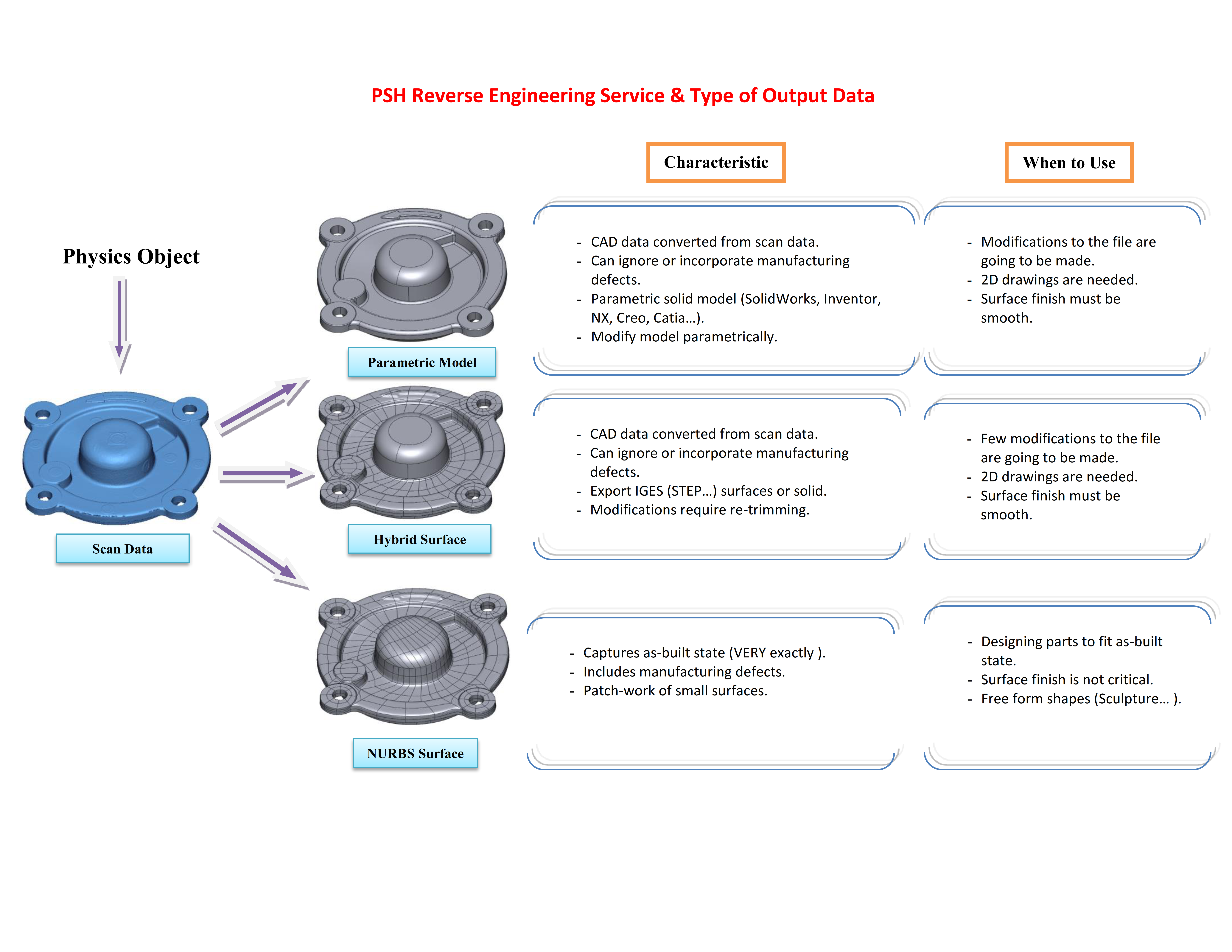
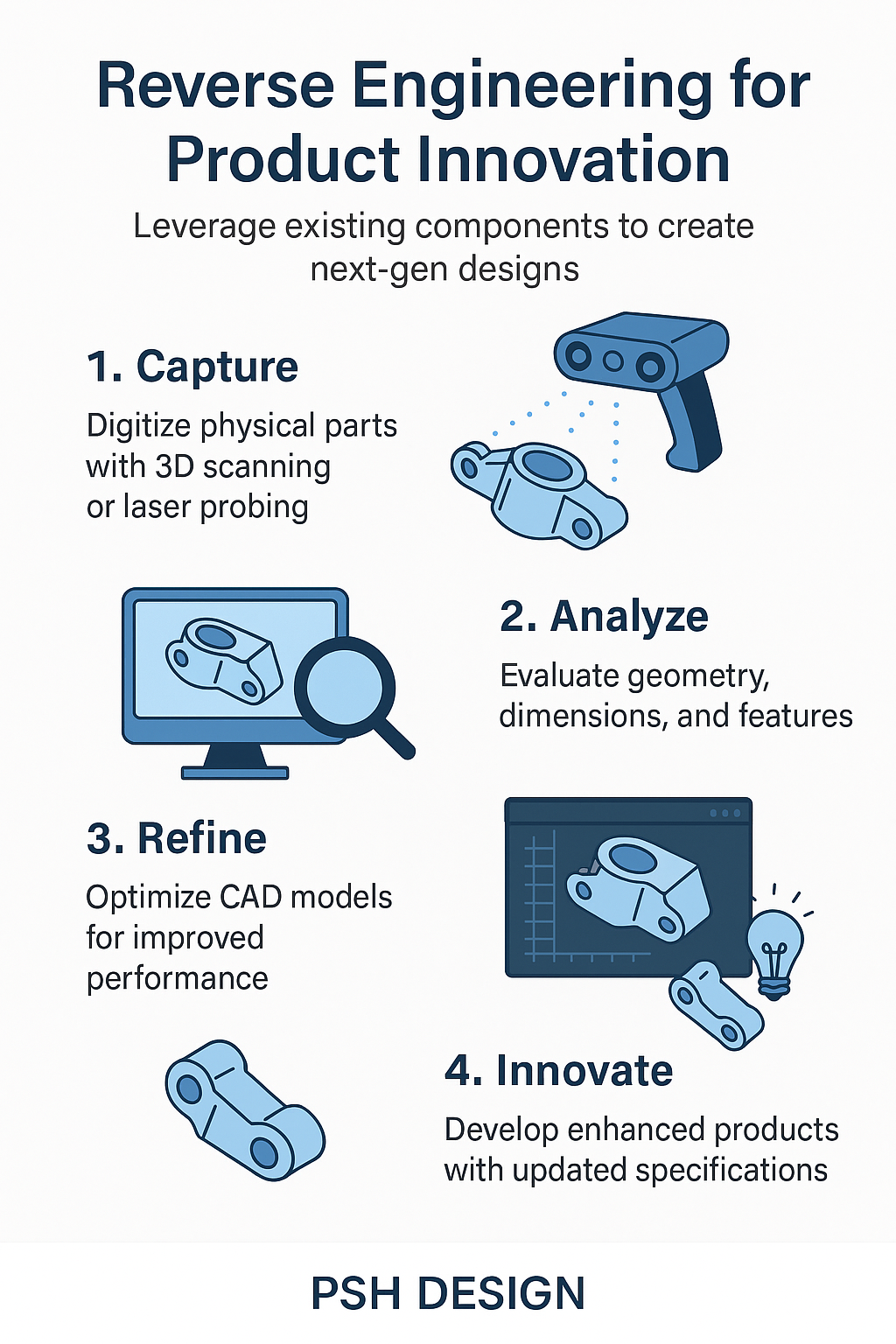
7. Reverse Engineering: From Physical Reality to Digital Precision
- CATIA leads in processing scanned data and converting point clouds into perfect Class A surfacing digital models.
- Siemens NX provides advanced modeling and simulation tools for validating legacy components digitally.
- PTC Creo offers efficient, user-friendly solutions for SMEs focused on rapid prototyping and iterative reverse engineering.
8. The Value of Community and Support Ecosystems
Choosing a CAD platform also involves selecting a vibrant community and dependable support network. CATIA and Siemens NX boast vast international user bases, extensive learning resources, and access to global outsourcing partners—including specialized companies like PSH Design. These ecosystems ensure expert guidance and timely assistance, enabling teams to successfully overcome complex design challenges.
9. Latest CAD Technology Trends
The CAD industry is rapidly evolving with major trends such as AI-powered generative design, cloud-based CAD, real-time collaboration, and automation. Immersive technologies such as Virtual Reality (VR), Augmented Reality (AR), and Digital Twin technology are enhancing design validation and manufacturing foresight. CATIA, Siemens NX, and PTC Creo integrate these advances to boost innovation and prepare businesses for future manufacturing demands.
10. Integration with Industry 4.0 Smart Manufacturing
Modern CAD platforms connect seamlessly with Industry 4.0 systems such as ERP, MES, IoT devices, and robotics automation. CATIA links automotive factory robots for real-time updates; Siemens NX’s Teamcenter PLM facilitates multi-disciplinary collaboration and efficient data flow; PTC Creo supports SMEs with scalable digital workflow solutions. These integrations reduce product lead times while improving manufacturing quality assurance.
11. Data Security and Design Management
With increasing cyber threats, protecting CAD data is crucial. CATIA and Siemens NX offer enterprise-grade encryption, granular permissions, version control, and cloud backups ideal for large organizations. PTC Creo’s scalable data governance caters to smaller teams ensuring intellectual property protection and regulatory compliance. PSH Design applies security standards aligned with ISO and GDPR requirements for business continuity.
12. CAD Training and Design Team Development
Maximizing CAD software value requires continuous training. Dassault Systèmes, Siemens, and PTC offer official certifications and training resources. PSH Design provides tailored workshops focusing on advanced Class A surfacing, parametric modeling, and reverse engineering, accelerating skill development. Participation in industry conferences and mentorship programs helps retain top talent while fostering innovation.
13. ROI Analysis and Cost-Benefit Case Studies
Investing in premium CAD tools delivers measurable returns by shortening design cycles, reducing reworks, and accelerating time to market. PSH Design case studies show clients reducing rework rates by up to 25% with CATIA, gaining 30% efficiency improvements through Siemens NX PLM, and achieving faster prototype iterations using Creo. Visual ROI models help clients make informed procurement decisions.
14. Custom CAD Implementation Strategies
PSH Design recommends tailored CAD deployments based on project complexity, simulation requirements, collaboration needs, and budgets. Combining strengths of CATIA, Siemens NX, and Creo into hybrid workflows, through needs assessments and pilot testing, ensures seamless integration and maximized value throughout adoption phases.
15. Driving Innovation and Precision with PSH Design’s CAD Engineering Expertise
In an era where design excellence, speed, and accuracy dictate market leadership, selecting the right CAD platform and leveraging advanced engineering capabilities is crucial. Whether you are a multinational automotive or aerospace giant, a medical device innovator, or a dynamic startup, CATIA, Siemens NX, and PTC Creo each offer unique strengths tailored to different needs and budgets.
However, technology alone is not enough. Success requires expert guidance to navigate complex software ecosystems, optimize workflows, ensure data security, and continuously train and empower your design teams. This is where PSH Design excels. With proven expertise in world-class Class A surfacing, integrated multidisciplinary design, and precision reverse engineering, PSH Design partners with you to unlock the full potential of your CAD investments.
Our bespoke consulting approach ensures that your CAD solution is tailored precisely to your project requirements, enabling scalable growth and sustained innovation. Coupled with deep industry knowledge and access to global resources, PSH Design stands as your dedicated partner in transforming visionary ideas into flawless, market-ready products.
Let PSH Design help you accelerate your product development journey with cutting-edge CAD engineering – turning your next visionary design into reality with efficiency, precision, and unmatched quality.
Contact us: https://pshdesign.com/rfq-free-test-project/
One case where the choice of system stops being yours: when a part is rebuilt from scan or CMM data for a customer, the model has to arrive in their CAD system — native and editable, not an imported body. If that comes up in your work, we set out how measurement and inspection companies deal with it in Scaling Inspection Services with a Reverse Engineering Partner.
Reverse engineering at PSH Design
Written for you if you run a metrology, CMM or 3D-scanning business — or an engineering team — and need scan or CMM data rebuilt as parametric CAD, delivered native in the system your customer works in. Not for you if you need a quick mesh for 3D printing, or modelling with no engineering intent behind it. We do not take that work, and saying so saves both sides time.
Read in this order:
- You Bought the Scanner. Who Builds the CAD? — what usable CAD means to the people downstream, and the two rebuild methods.
- What CAD In-House Costs, What a Day Costs, and What Actually Grows a Lab — software, training, lead time, and the number most quotes leave out.
- Scaling Inspection Services with a Reverse Engineering Partner — how an inspection business adds CAD capacity through a partner rather than a department.
- Reverse Engineering Services — formats, tolerances, lead times and terms.
Then judge the work, not the words: send one part — a scan, a CMM report or a drawing — and we build it at our cost →
PSH Design
17+ years of CAS, Class A Surfacing, CAD and Reverse Engineering for Automotive, Aerospace, Medical and Industrial, to OEM standard.
Concept Design & CAS · Class A Surfacing · CAD Engineering · Reverse Engineering
Work of this kind is easier to judge than to describe.