The Best Metrology 3D Scanners- Buyer’s Guide for Reverse Engineering and Quality Inspection
Metrology 3D Scanners:
A Practical Buyer’s Guide for Reverse Engineering and Quality Inspection
PSH Design — 17+ years of Class A surfacing and scan-based reverse engineering | Updated March 2026
We receive scan data from metrology companies every week. Some of it is excellent — clean point clouds, solid volumetric accuracy, well-documented registration strategy. Some of it arrives with problems that only reveal themselves three days into a Class A rebuild: subtle misalignment drift, noisy surfaces that appear acceptable in mesh view but create ripple artefacts when converted to NURBS, or photogrammetry skipped on a 1.2-meter panel that should have required it.
After 17+ years of working with scan data for automotive reverse engineering and Class A surfacing, we have a specific perspective on metrology 3D scanners that is different from most buyer’s guides: we evaluate scanners not by their datasheet number but by the quality of the data they produce when operated by a real team, under real conditions, for real downstream CAD work.
This guide is written for engineers, quality managers, and business owners who need to make an informed hardware decision in 2026 — or who need to evaluate whether their current scanning workflow is producing data their downstream partners can actually use.
Already own a scanner? The hard step is no longer capturing the data — it is turning the mesh into CAD that somebody downstream can actually use. That question is covered in You Bought the Scanner. Who Builds the CAD?, and in commercial terms — what the capability costs to build in-house, and what a day of lead time is worth — in the companion article.
1. The 3D Metrology Market in 2026: What Has Actually Changed
The global 3D metrology market reached approximately $11.5–12.6 billion in 2025, growing at a compound annual rate of 7–9%. The scanner segment alone is projected to approach $7 billion by 2034. These are not particularly surprising numbers — what is more interesting is what is driving the growth and what it means for buyers.
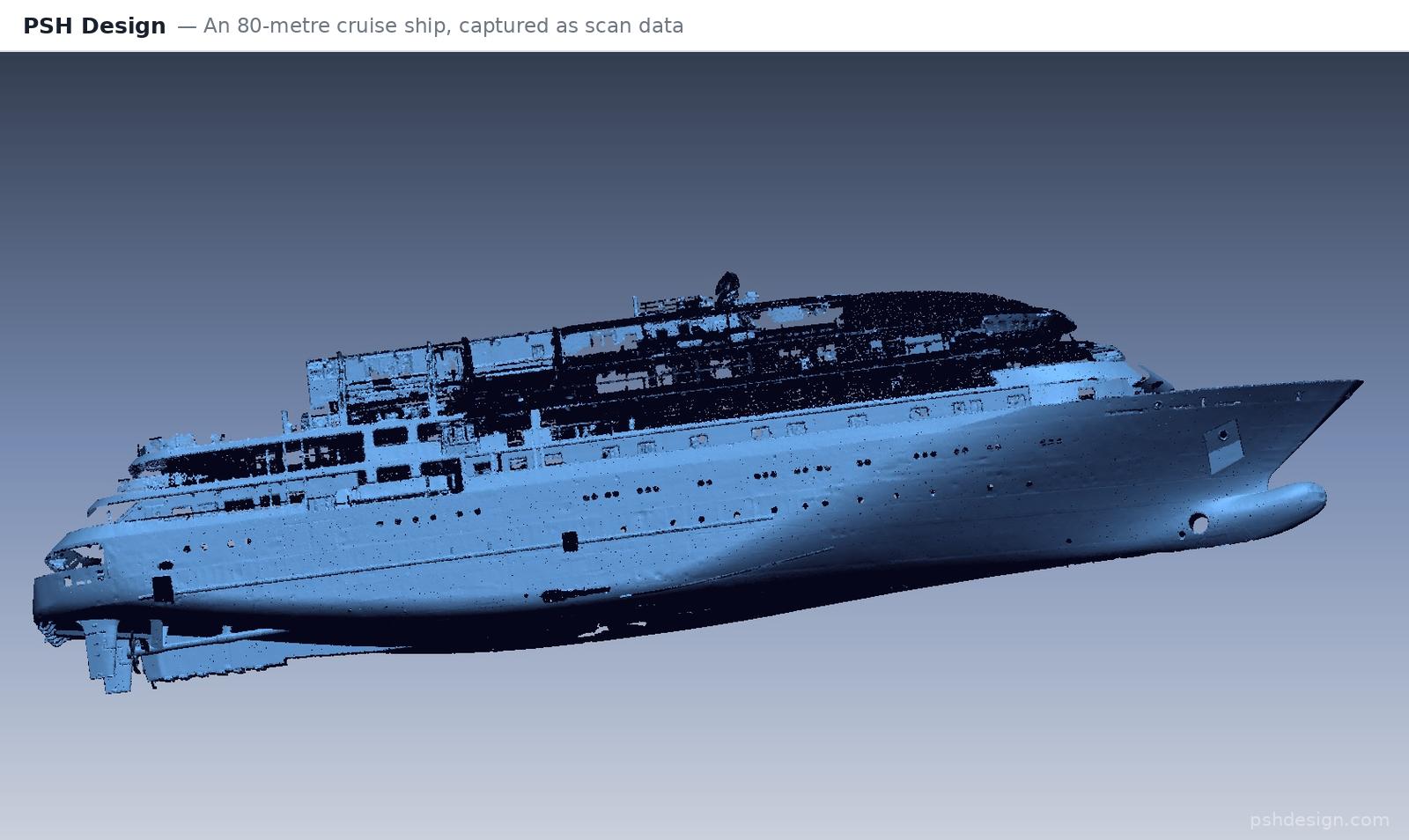
The most significant structural shift of the past five years is the move from CMM-first workflows to what the industry is increasingly calling “scan-first, CMM-verify.” Body panels, plastic trim, injection-molded parts, castings, and composite shells are now overwhelmingly scanned rather than probed. CMM machines still hold roughly 35–38% of metrology hardware spend in 2025, driven by aerospace, precision machining, and any application where traceable sub-10-micron accuracy is a contractual requirement. But for everything else, the portable handheld laser scanner has become the default tool.
The second major shift is inline and near-line automation. Robot-mounted structured light systems (ZEISS ATOS R-Series, Creaform R-Series) are now standard in high-volume automotive body-in-white lines. What was a specialist integration five years ago is now a procurement line item.
The third shift — the one that will matter most over the next three years — is AI-driven inspection analytics. Not AI replacing the scanner operator, but AI processing the deviation datasets to identify systematic process drift, flag outlier parts, and generate actionable quality reports without a metrology engineer reviewing every heatmap manually.
For buyers in the US market, the practical implication of all three trends is this: the scanner hardware itself has become less differentiated at the top of the market. Creaform, ZEISS, Hexagon, and FARO all produce instruments capable of meeting most industrial inspection requirements. The differentiating factor today is software depth, workflow integration, and — most importantly — the metrology thinking of the team operating the system.
PSH perspective: The shift we have seen most concretely over the past three years is not in hardware specs — it is in how frequently scan data now arrives in our RE workflow as the primary dimensional reference, replacing CMM reports entirely for body panels, plastic assemblies, and castings. The hardware trigger is complete. The bottleneck has moved downstream.
2. The Top Metrology 3D Scanners in 2026: Quick Comparison
The table below covers the instruments we consider most relevant for industrial metrology and reverse engineering in 2026. Accuracy figures are nominal datasheet values under certified test conditions; real-world volumetric performance on large parts in shop-floor environments will typically be higher. See Section 6 for our notes on which specifications actually matter.
| Scanner / Model | Type | Accuracy | Vol. Accuracy | Speed (pts/s) | Best For | Price Tier |
|---|---|---|---|---|---|---|
| Creaform HandySCAN BLACK Elite | Handheld laser | 0.025 mm | 0.020 + 0.040 mm/m | 1.3–1.8M | Shop-floor RE, inspection, large parts | $$$$ |
| ZEISS ATOS Q | Structured light | ~0.01–0.02 mm* | Config-dependent | 8M pts/scan | Tooling, casting, automated cell | $$$$$ |
| ZEISS ATOS 5 | Structured light | ~0.01 mm* | Config-dependent | 12M pts/scan | OEM inline/near-line, BIW | $$$$$ |
| Shining3D FreeScan UE Pro | Handheld laser | 0.02 mm | 0.020 + 0.030 mm/m | ~1.85M | Metrology-grade, budget-sensitive | $$$ |
| Hexagon Absolute Arm + RS6 | Arm + laser | < 0.03 mm* | Arm-length dependent | High | Portable CMM + scanning, large fixtures | $$$$$ |
| FARO Quantum Max Arm + LLP | Arm + laser | < 0.03 mm* | Arm-length dependent | High | Fabrication, machining, automotive | $$$$ |
| Artec Leo | Structured light | ~0.1 mm | — | ~3M | RE, QC without formal certification | $$$ |
| Artec Space Spider | Structured light | ~0.05 mm | — | Medium | Small parts, high detail | $$$ |
| ScanTech KSCAN-Magic | Hybrid laser+IR | 0.02 mm | 0.020 + 0.035 mm/m | High | Value alternative to HandySCAN | $$$ |
* Accuracy varies by measuring volume configuration. Always request VDI/VDE 2634 or ISO 17025 certified test reports for the specific configuration you intend to deploy.
Price tiers: $$$ = ~$25k–60k | $$$$ = ~$60k–120k | $$$$$ = $150k–500k+ (full cell system)
3. Scanner Notes: What Each Instrument Is Actually Good For
The comparison table in Section 2 covers specifications. This section adds the practical context that specs alone do not convey — which instrument fits which workflow, and where each one falls short.
Creaform HandySCAN BLACK Elite
The field standard for portable metrology scanning. Third-generation optics, dynamic referencing, deep VXelements integration. Robust on shop floors, in confined spaces, on large assemblies with photogrammetry. High capital cost — typically $80,000–100,000+ fully configured — but the workflow reliability justifies it for organizations doing serious inspection or RE work daily.
ZEISS ATOS Q and ATOS 5
Structured light systems for controlled environments. The ATOS Q covers the mid-range — compact, five interchangeable lenses, works manually or in automated cell configurations (ScanCobot, ScanBox). The ATOS 5 is the high-end production instrument: 12 million points per scan, GPU processing, sub-second capture for inline body-in-white inspection. GOM software has transitioned to ZEISS INSPECT within the ZEISS Quality Suite — architecture improved, functionality preserved. Budget $150,000–300,000+ for a complete system.
FARO Quantum Max Arm + Hexagon Absolute Arm
Both are portable CMM arms with integrated laser line scanners — the hybrid approach that gives you traceable probing for holes and GD&T features alongside surface scanning in a single session. FARO CAM2 and Hexagon PC-DMIS/QUINDOS define the respective software ecosystems. Strong choice for fabrication and machining environments where both probing and scanning are needed. Arm reach limits scanning volume; register carefully on large parts.
Artec Leo and Space Spider
Leo: self-contained handheld structured light, onboard processing, no laptop needed. AI HD mode in Artec Studio (2024–2025) delivers cleaner mesh. Good for reverse engineering at lower entry cost. Not formally certified for metrology inspection — third-party software required for GD&T work. Space Spider specializes in small, high-detail geometry (~0.05 mm accuracy). Both are practical for RE work where formal certification is not the requirement.
Shining3D FreeScan UE Pro and ScanTech KSCAN-Magic
The credible value alternatives to Creaform in the certified handheld category. FreeScan UE Pro: VDI/VDE 2634 Part 3 certification, 0.02 mm single-point accuracy, 26+5+1 blue laser lines, ~$40,000–60,000. KSCAN-Magic: hybrid laser+infrared, similar accuracy claims, competitive on price. Both have expanded US and EU presence in 2024–2025. Ecosystem maturity and field service support are the honest differentiators versus Creaform — evaluate those alongside the spec sheet.
PSH perspective: We have processed scan data produced by all the major platforms listed above. The variation in downstream CAD quality is not determined by brand. We have received excellent data from mid-range hardware operated by experienced teams, and data that required partial rescan from top-tier instruments operated without photogrammetry discipline on large parts. The scanner is a constraint only when it becomes the weakest component in the workflow.
4. Three Technology Shifts That Matter in 2026
4.1 AI-Powered Inspection Analytics
AI is entering metrology through the software layer, not the hardware layer. The scanner itself is not changing fundamentally — what is changing is what happens to the deviation data after the scan.
PolyWorks|Inspector 2025 introduced fixtureless pre-alignment for portable scanning (the scanner begins with auto-alignment guidance rather than requiring physical fixture setup), real-time coverage feedback, and GD&T enhancements that produce actionable deviation information rather than raw numbers. Geomagic Control X has pushed its Visual Scripting and Automation Server capabilities to the point where routine inspection workflows can run with minimal engineer intervention — what the industry is calling “lights-out inspection” for high-volume datasets. ZEISS INSPECT 2025 adds surface defect trend analysis, PiWeb analytics integration, and photorealistic rendering for stakeholder-ready reporting.
None of this replaces metrology expertise. Automated inspection programming still requires someone who understands GD&T stack-up, process capability, and what a deviation map is actually telling you about the manufacturing process. But it does mean that organizations with strong metrology software skills will pull further ahead of those who are still manually reviewing every scan report.
4.2 Structured Light vs. Laser: The Right Answer Depends on the Job
This is a question we are asked regularly by reverse engineering clients who are evaluating or upgrading their scanning equipment. The honest answer in 2026 is that both technologies are mature and capable — the choice depends on what you are scanning and how you intend to use the data.
- Structured light (ATOS Q/5, Artec): Full-field, high-density data per scan. Extremely fast on surface geometry. Best for tooling, casting, body-in-white, automated cells. More sensitive to ambient lighting, surface reflectivity, and vibration. Requires controlled setup for optimal results.
- Laser handheld (HandySCAN, FreeScan, KSCAN): More robust on difficult surfaces — dark materials, carbon fiber, matte plastics, and moderately reflective surfaces. Better for shop-floor and onsite work. Easier to manage in confined spaces. Data density lower per scan pass, but cumulative coverage on complex parts is practical.
For automotive reverse engineering specifically — which accounts for most of the scan data PSH receives — laser handheld scanners at metrology grade dominate for a practical reason: the parts being scanned are often irregular, partly assembled, sometimes mounted on fixtures in inconvenient positions. The portability and surface tolerance of laser handheld scanners match those real-world conditions better than stationary structured light.
4.3 Inline Automation and Closed-Loop Manufacturing
For production environments, the most significant trend is the integration of scanning data directly into manufacturing execution and statistical process control systems. Robot-mounted ATOS and Creaform R-Series cells already enable 100% inspection or high-frequency sampling on body lines. The next stage — which is already in deployment at leading OEMs — is closed-loop manufacturing: deviation data feeds back to the production line automatically, triggering corrective process adjustments before non-conforming parts accumulate.
This is relevant for buyers in the inspection services sector because it defines where the high-volume automated inspection work is going. Inline cells are OEM-owned and not outsourced. What remains outsourced is the complex, irregular, low-volume work — which is precisely where handheld metrology expertise and scan-to-CAD capability have the highest value.
5. Inspection Software in 2026: What You Need and What It Costs
A metrology 3D scanner is only as useful as the software it operates with. For most industrial inspection applications, the scanner’s proprietary acquisition software handles data capture but is insufficient for formal GD&T inspection, deviation reporting, or scan-to-CAD work. A separate inspection platform is required.
|
Software |
Key Strength | Typical User | Price (USD) | Verdict |
|---|---|---|---|---|
| Geomagic Control X | Automation, Visual Scripting, airfoil modules | Aerospace suppliers, automotive Tier-1 | ~$10–15k+ / license | Best-in-class automation |
| ZEISS INSPECT (GOM) | Deep ATOS integration, GD&T, surface defect trend | OEM/Tier-1 in ZEISS ecosystem | App-based, varies | Unbeatable with ATOS |
| PolyWorks|Inspector | Universal device support, hybrid CMM+scan, fixtureless | Large OEMs, multi-device environments | ~$10–15k + $2k/yr | Best universal platform |
| VXinspect / VXelements | Optimized for Creaform hardware, simple workflow | SME, service bureaus, shop-floor | Bundled with scanner |
Best if you own HandySCAN |
The practical recommendation for most US metrology service companies and engineering organizations is determined primarily by the scanner ecosystem you operate within. If you run Creaform hardware, VXinspect is sufficient for standard inspection and the barrier to adding Geomagic Control X for more complex work is low. If you are in a multi-device environment with CMMs, laser trackers, and scanners from different manufacturers, PolyWorks|Inspector is the most practical universal platform. If your work is deeply integrated with an OEM or Tier-1 operating a ZEISS/GOM ecosystem, ZEISS INSPECT is the path of least resistance.
Software cost is a significant budget item that is frequently underestimated. A Geomagic Control X or PolyWorks|Inspector license at $10,000–15,000 upfront plus $2,000/year maintenance is sometimes more than the entry-level scanner hardware cost. Include it in your total system budget from the beginning.
PSH perspective: In practice, scanner buyers underestimate their total software budget by 30–50% with consistent regularity. The conversation focuses on hardware price and misses the inspection platform, maintenance, training, and the downstream CAD software needed to turn inspection-grade data into usable engineering output. Budget for the full pipeline, not the scanner in isolation.
6. CMM vs. 3D Scanner in 2026: An Honest Comparison
CMM machines are not going away. Anyone who has read an article suggesting that 3D scanning has made CMMs obsolete should treat that claim with the same skepticism they would apply to any technology maximalism. The reality in 2026 is more nuanced.
When CMM remains the right tool
- Safety-critical feature inspection requiring sub-10-micron traceability (bearing seats, bores, aerospace engine components)
- Contractual requirements for ISO 10360 compliance, FAI, or PPAP with specific GD&T features
- Gear measurement and tactile form evaluation where the physics of contact probing is non-negotiable
- Calibration reference and audit functions in ISO-certified quality systems
When 3D scanning has definitively replaced CMM
- Body panels, plastic trim, injection-molded parts, composite shells — full-field surface data
- Tooling verification, fixture check, large casting form inspection — no practical alternative
- Rapid troubleshooting, warpage study, digital twin capture — speed advantage is decisive
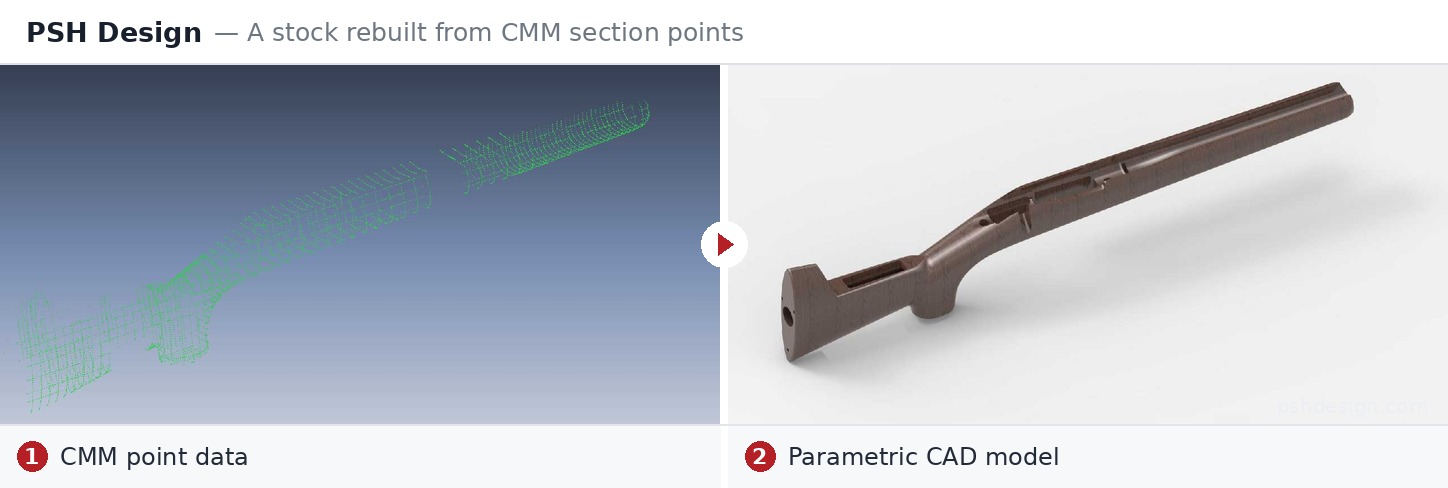
- Reverse engineering of complex geometry — point-by-point probing cannot reconstruct freeform surfaces
The hybrid model: scan-first, CMM-verify
The most efficient workflow in most modern manufacturing environments combines both tools. Scanning provides full-field surface intelligence and rapid screening. CMM provides traceable point measurement on critical features. The scanner identifies where problems exist; the CMM confirms the magnitude of deviation on features where the contractual tolerance requires certified measurement. Portable CMM arms (Hexagon Absolute Arm, FARO Quantum Max) that integrate both scanning and probing in a single instrument are the practical expression of this hybrid model.
7. What Actually Matters When Choosing a Metrology 3D Scanner
7.1 Accuracy requirements by application
| Application | Typical Tolerance | Scanner Requirement | CMM Still Needed? |
|---|---|---|---|
| Automotive body panel | ±0.3–0.5 mm skin; ±0.1–0.2 mm gap/flush | Volumetric ≤ 0.05–0.1 mm | No, for form/shape |
| Aerospace machined parts | ±0.01–0.05 mm | High-end structured light + CMM | Yes, for critical features |
| Medical device (plastic) | ±0.05–0.1 mm | Metrology-grade scanner | Depends on classification |
| Medical implant | ±0.01–0.02 mm | CMM primary | Yes |
| Reverse engineering (aftermarket) | ±0.05–0.2 mm | Handheld laser 0.02–0.05 mm | No, for most RE work |
| General manufacturing QC | ±0.05–0.2 mm | Mid-range metrology scanner | For reference/audit only |
7.2 Price tiers in 2026
- Entry-level ($25k–60k): Shining3D FreeScan series, ScanTech KSCAN, Artec Leo. Suitable for SME inspection, non-safety-critical RE work. Accuracy ~0.02–0.05 mm nominal.
- Mid-range ($60k–120k): Creaform HandySCAN BLACK Elite, FreeScan UE Pro, FARO Arm entry configurations. Certified metrology-grade performance. Recommended for serious inspection service organizations.
- High-end cell ($150k–500k+): ZEISS ATOS Q/5 cells, Creaform R-Series, Hexagon robotic cells. OEM and Tier-1 inline/near-line inspection. Not relevant for most service bureaus.
- Leasing and scanning-as-a-service: Increasingly common at Tier-1 and Tier-2 level. For low-volume inspection work, outsourcing to a metrology service company at $100–200+/hour is frequently more economical than capital investment plus staffing.
7.3 The specifications that marketing inflates
After years of receiving scan data from various sources, we have a clear view of which specifications on a scanner datasheet matter for real work and which are routinely inflated.
- Single-point accuracy is often meaningless in isolation. A scanner rated at 0.020 mm single-point accuracy can produce volumetric drift of 0.5 mm or more on a 1.5-meter part if photogrammetry is skipped or temperature compensation is inadequate. Always ask for volumetric accuracy figures, certified to VDI/VDE 2634 or ISO 17025, for the scan volume you will actually be using.
- “Maximum speed” in points per second ignores total workflow time. Scanning speed is only one component. Registration time, mesh processing, alignment, and inspection programming often take longer than the scan itself. Evaluate end-to-end cycle time for your specific workflow, not hardware acquisition rate.
- Resolution specs can be counterproductive for reverse engineering. An extremely fine point spacing produces large, noisy files that are harder to process into clean NURBS surfaces. For most automotive RE work, point spacing of 0.1–0.3 mm with low noise is more useful than maximum-resolution data that requires aggressive denoising.
7.4 The factor that determines success: metrology thinking
After 17+ years of receiving scan data from a wide range of sources and operators, PSH’s clearest observation about scanner performance is this:
The scanner is the camera. The team operating it — and their understanding of registration strategy, photogrammetry, GD&T, and stack-up tolerance — is what determines whether the data is useful.
We have seen excellent data produced with mid-range scanners operated by experienced metrology engineers, and unusable data produced with top-tier hardware operated by teams that skipped photogrammetry on large parts, used insufficient marker density, or failed to temperature-stabilize the scanner before beginning. The best investment for organizations that already own capable hardware is often metrology training and workflow discipline, not a hardware upgrade.
Which raises the question a specification table cannot answer: once the data is captured, who turns it into CAD? For a lab that owns the scanner and then gets asked for the model as well, that is a separate trade with its own methods and its own numbers — set out in You Bought the Scanner. Who Builds the CAD? The commercial side of the same decision is in What CAD In-House Costs, What a Day Costs, and What Actually Grows a Lab.
8. Reverse Engineering: What It Actually Is — and the Value It Creates When Done Right
PSH Design has been providing reverse engineering services since 2009 — continuously, roughly 300 parts and 3,000 design hours a year, for clients in the US, Germany, Scandinavia, and Japan. This section is written from that accumulated operational experience. It is not a product description. It is what we have actually learned.
8.1 The misconception that limits most RE outcomes
The most common misunderstanding in reverse engineering — shared by clients, scanning companies, and many RE providers — is that the process is essentially this: scan the part, create a 3D model, deliver the file.
This framing is wrong, and it is why a large proportion of RE outputs fail to create the value the client expected.
A 3D scanner is a measurement instrument. It captures the geometry of a physical object with high precision. What it cannot capture is the engineering reasoning embedded in that object — the decisions about material, process, tolerance, draft, wall thickness, feature sequence, and assembly relationship that the original designer made and that are invisible in the physical form. Recovering those decisions — reconstructing not just the shape but the engineering logic behind it — is where the actual skill in reverse engineering resides.
A metrology scanner captures what the part looks like. Engineering knowledge and experience reconstruct why it was designed that way — and that understanding is what makes the output usable, modifiable, and genuinely valuable.
When a mechanical engineer with manufacturing experience processes scan data, they are not tracing geometry. They are reading the part: identifying the datum structure, recognizing machining marks that indicate tolerance intent, interpreting wall thickness as a material and process decision, reconstructing draft angles from mold geometry, detecting misregistration in the scan that will create a dimensional error if accepted as truth. This filtration layer — experienced engineering judgment applied to raw scan data — is what separates professional RE output from a 3D file that happens to look like the right shape.
8.2 What professional RE output actually enables
When reverse engineering is done correctly, it creates disproportionate value — far beyond the cost of the RE work itself.
- Design lead time compression: A well-structured parametric model of an existing part eliminates weeks or months of design work from scratch. The engineering team starts from a dimensionally accurate, modifiable foundation rather than a blank canvas. Complex assemblies that would take months to model from reference drawings can be in engineering use within days of a scan.
- Platform for innovation: Properly reconstructed parametric data is not a record of what exists — it is a starting point for what comes next. Engineers can modify wall thickness for a new material, adjust mounting geometry for a new application, optimize weight while preserving function, or derive a family of variants from a single master model. Legacy parts that were previously impossible to improve become development assets.
- Knowledge preservation: Manufacturing knowledge embedded in physical parts — tooling, fixtures, legacy components without surviving documentation — becomes accessible and modifiable. Organizations can rebuild institutional knowledge that would otherwise be lost when equipment ages, suppliers change, or original designers leave.
- Supplier and process independence: A native parametric model in the client’s CAD system can be taken to any manufacturer, analyzed by any CAE tool, and modified by any competent engineer on the team. The client owns the knowledge, not the vendor.
None of this is achievable with a neutral format file delivered by a provider who scanned the part and ran auto-surfacing software. It requires engineers who understand both the scan data and the engineering domain the part belongs to.
8.3 The two output types — and the real cost difference
Neutral format: STP, X_T, IGS
Neutral format files transfer 3D geometry between CAD systems. They are readable everywhere, deliverable quickly, and typically priced to reflect that speed. For visualization or as a rough geometric reference, they serve their purpose.
The limitation is immediate in any real engineering context: no feature history, no parametric relationships, no design intent. A wall is merged geometry, not a parametric extrude with a controllable thickness. A hole is a void in a solid body, not a positioned, dimensioned feature the engineer can modify or suppress. When the part needs to change — for a new supplier, a new material specification, a design iteration — the client rebuilds from neutral geometry rather than editing a parametric model. This is where the real cost accumulates.
Neutral format files are sold by the scan. Parametric native CAD is sold by the engineering value it enables. The price difference is visible upfront. The cost difference only becomes visible downstream.
Native parametric CAD: SolidWorks, NX, CATIA, Inventor, Solid Edge, Creo
Native parametric files reconstruct the part as an engineering model — a sequence of operations with a clean feature tree, parametric dimensions, constrained relationships, and reference geometry that reflects how a competent engineer would have designed the part from the start. When the file is opened in the client’s system, the engineering team works with it as they would with any model they designed themselves.
This requires the RE designer to work in the client’s CAD environment natively, not export to it. It also requires manufacturing domain knowledge specific to the part type: injection-molded plastic housings require different reconstruction logic than stamped sheet metal brackets or die-cast aluminum structures. PSH designers cover these domains — plastics, sheet metal, casting, composite thin-wall, precision machined components — as part of standard RE work, not as specialty add-ons.
8.4 PSH’s terms and commitment
PSH has US clients who have worked with us continuously for more than 11 years. That duration reflects a specific commercial and operational reality: we deliver native parametric output that the client’s engineering team can use, modify, and extend without coming back to us to rebuild it. When they do come back — for the next project, the next design iteration, the next derivative part — the accumulated context from previous work makes every engagement faster and more accurate than the last.
- NET 30 after client acceptance: Final payment is due after the client confirms the deliverable meets their requirements. PSH carries the delivery risk. This is only viable because our output quality is consistent enough to support the commitment.
- Multi-platform native CAD: SolidWorks, CATIA, NX, Inventor, Solid Edge, Creo — whichever system the client’s team operates in.
- Manufacturing domain coverage: Injection molding, sheet metal and stamping, casting, composite and thin-wall structures, precision machined components.
- Free test project: PSH will complete a sample RE task at no cost — same scope and complexity as real project work — before any commitment. The fastest way to verify output quality and understand cost for comparable work. No sales call required.
Request a free test: pshdesign.com/rfq-free-test-project — describe the part, attach scan data or a drawing, and receive a real sample output.
8.5 Automotive, classic car restoration, and bodykit RE
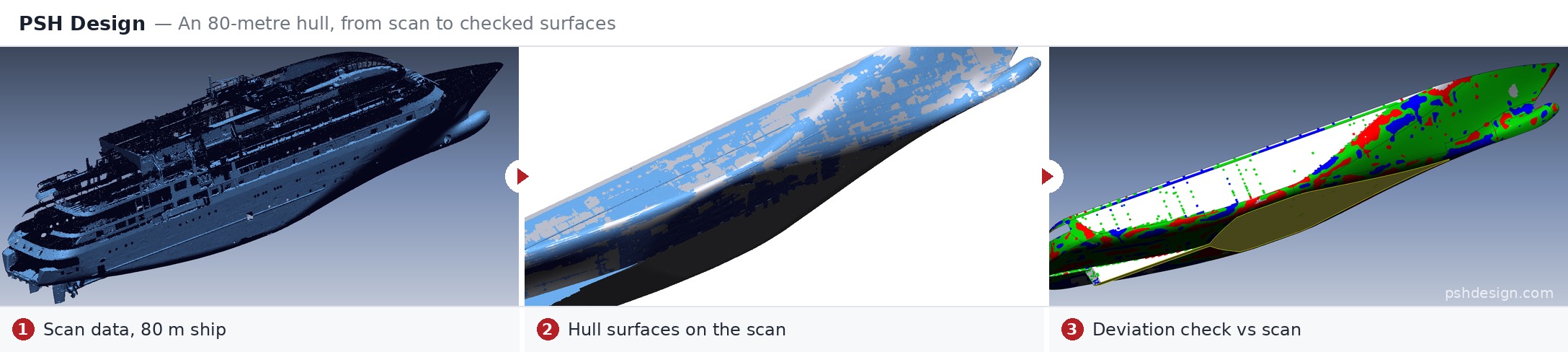
A distinct subset of reverse engineering involves freeform surface geometry — automotive exterior panels, classic car body restoration, custom bodykit development in carbon fiber or fiberglass. These parts are defined by surface curvature and aesthetic continuity that solid modeling tools cannot reconstruct adequately.
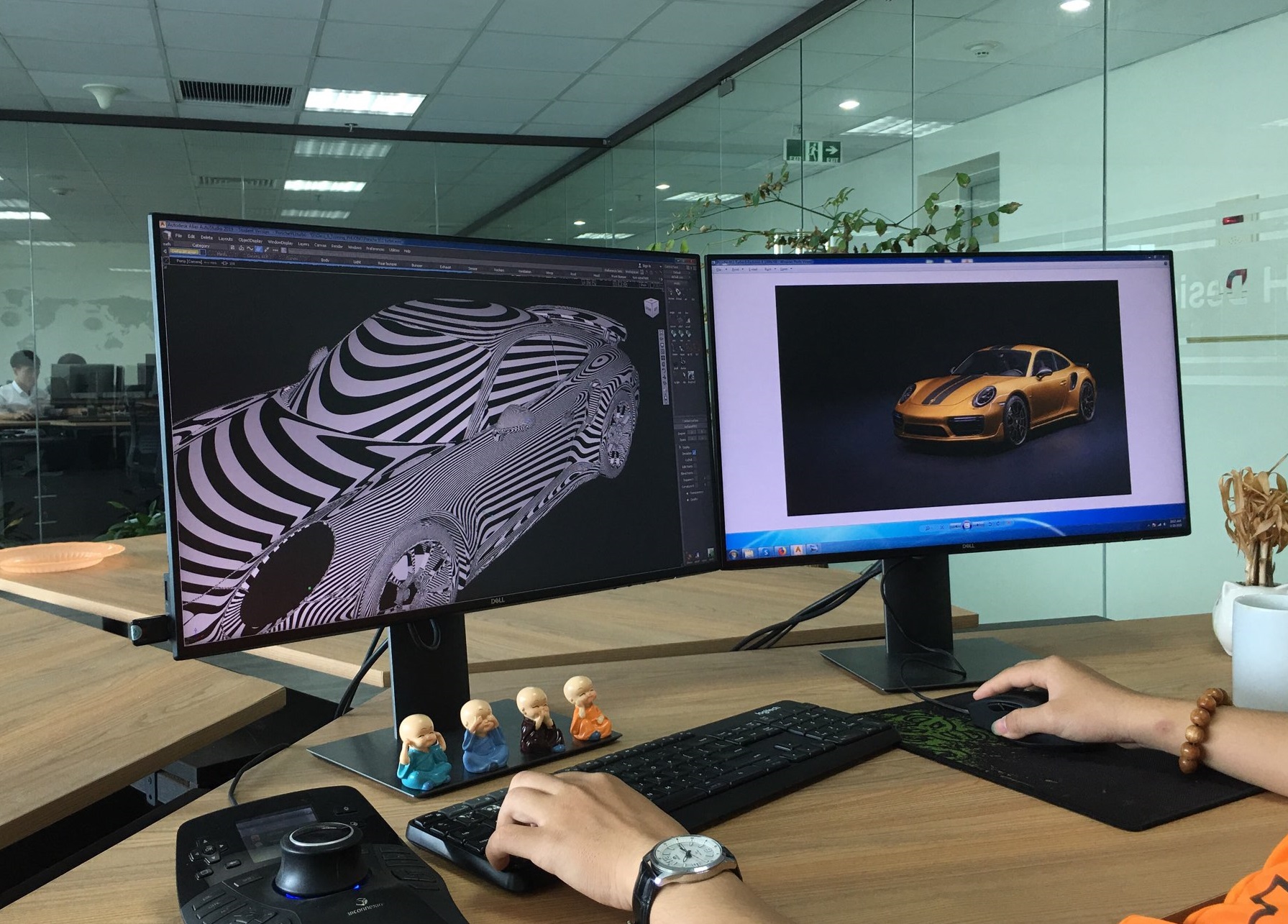
For this work, PSH routes critical surfaces through CATIA surfacing tools or Autodesk Alias, which are purpose-built for the surface quality requirements of automotive exterior and styling work — including Class A curvature standards where required. The scan data requirements, workflow, and output quality criteria for this application are different enough from general industrial RE to warrant a dedicated discussion.
A dedicated article covering automotive and restoration RE workflows is in preparation — exterior panel digitization, classic car restoration, custom bodykit development (carbon fiber / fiberglass).
9. Frequently Asked Questions
Q: What is the most accurate 3D scanner available in 2026?
For non-contact scanning, high-end structured light systems (ZEISS ATOS 5, ATOS 5X) and laser trackers achieve accuracy in the single-digit micron range on controlled volumes. For portable handheld metrology, the Creaform HandySCAN BLACK Elite and Shining3D FreeScan UE Pro achieve 0.020–0.025 mm under certified conditions. Bridge and gantry CMMs remain the reference standard for sub-micron traceable measurement.
Q: Will AI replace CMM machines for metrology inspection?
No — and the question conflates two separate trends. AI is improving scan-based inspection analytics: faster deviation processing, automated defect recognition, trend reporting without manual review. That is real progress. But AI does not alter the physics of traceable reference measurement that CMMs provide for safety-critical features. See Section 6 for the full CMM vs. scanner breakdown; the short answer is that both tools remain necessary and serve different purposes.
Q: How do I scan shiny or dark surfaces?
This remains a real challenge despite claims of improvement. Laser handheld scanners (HandySCAN, FreeScan) are more robust on problematic surfaces than structured light systems. For highly polished metal or deeply black surfaces, chalk-based evaporating spray remains the most reliable solution. Use titanium dioxide-free formulations to minimize dimensional impact. Blue laser wavelengths handle dark surfaces better than red laser. For structured light high-end + polished tooling: spray is still the most consistent approach.
Q: Should I buy a scanner or outsource to a metrology service company?
The decision turns on scan volume and internal expertise. If your organization needs scanning more than once a week, and you have the technical capacity to operate and maintain the equipment properly, ownership is typically more economical beyond a two-year horizon. If you need scanning infrequently, or your team lacks metrology expertise, outsourcing at $100–200+/hour for professional service is almost always the better economic and quality outcome. The hidden cost of poorly operated in-house equipment — both in data quality and equipment maintenance — is consistently underestimated.
Q: What is the difference between Sub-D modeling and NURBS in scan-to-CAD workflows?
Scan data is processed into a polygon mesh, which is then used as a reference for surface reconstruction. NURBS surfaces (the standard for Class A and production CAD) are mathematically exact but require skilled surface modeling to construct correctly from mesh data. Sub-D modeling provides an intermediate step — flexible enough for rapid concept iteration, structured enough to convert into NURBS when production data is required. For automotive body and interior reverse engineering, PSH uses a Class A-ready modeling approach from the first pass, which reduces rework at the NURBS conversion stage.
Q: How long does 3D scanning take for reverse engineering?
For a typical automotive interior component (door panel, instrument panel section), professional scanning including photogrammetry setup takes 2–6 hours. Mesh processing and preparation for CAD reconstruction adds another 2–4 hours. Total time from part arrival to scan-ready reference data: typically one working day for most parts. The CAD reconstruction stage — the reverse engineering work itself — is separate and typically quoted on project scope.
If You Need a Reverse Engineering Partner: Working With PSH Design
PSH Design provides scan-based reverse engineering and surfacing services for industrial and automotive clients in the US, Europe, and Japan. We work from scan data supplied by your metrology team or through our network of US metrology partners.
If you are evaluating whether your scan workflow produces data that will support high-quality parametric CAD reconstruction, we are happy to review a sample dataset and give you a direct technical assessment — no cost, no commitment.
If you have an active reverse engineering project — industrial components, mechanical assemblies, or automotive parts requiring native parametric CAD output — contact us directly. Response within 24 hours.
Contact PSH Design: https://pshdesign.com/rfq-free-test-project/
Reverse engineering at PSH Design
Written for you if you run a metrology, CMM or 3D-scanning business — or an engineering team — and need scan or CMM data rebuilt as parametric CAD, delivered native in the system your customer works in. Not for you if you need a quick mesh for 3D printing, or modelling with no engineering intent behind it. We do not take that work, and saying so saves both sides time.
Read in this order:
- You Bought the Scanner. Who Builds the CAD? — what usable CAD means to the people downstream, and the two rebuild methods.
- What CAD In-House Costs, What a Day Costs, and What Actually Grows a Lab — software, training, lead time, and the number most quotes leave out.
- Scaling Inspection Services with a Reverse Engineering Partner — how an inspection business adds CAD capacity through a partner rather than a department.
- Reverse Engineering Services — formats, tolerances, lead times and terms.
Then judge the work, not the words: send one part — a scan, a CMM report or a drawing — and we build it at our cost →
Relative topic :
3D Reverse Engineering & AI Design: The Future Foundation of Medical Device Innovation
Scaling Inspection Services with a Comprehensive Reverse Engineering Partner
MetrologyScanner #ReverseEngineering #3DScanning #QualityInspection #ClassASurfacing #PSHDesign
PSH Design
17+ years of CAS, Class A Surfacing, CAD and Reverse Engineering for Automotive, Aerospace, Medical and Industrial, to OEM standard.
Concept Design & CAS · Class A Surfacing · CAD Engineering · Reverse Engineering
Work of this kind is easier to judge than to describe.