A reverse engineering partner supplies the CAD half of an inspection business: your team measures the part, the partner turns CMM data or scan meshes into native parametric models, negative CAD, Class A surfaces and drawings — delivered under your name, without hiring CAD engineers or buying licences.
Adding Reverse Engineering to an Inspection Business: What the Lab Keeps, What We Build
日本語版はこちら → · Deutsche Version →
A reverse engineering partner does the CAD half of an inspection business: the lab measures the part, the partner turns the CMM data or scan mesh into native CAD, and the lab delivers it under its own name. The lab sells the whole engineering scope without hiring CAD engineers or buying licences. PSH Design has done this since 2009 — roughly 300 parts and 3,000 design hours a year, without a failed part — for labs in the United States, Canada, Germany, Sweden, Austria and Australia.
Sooner or later a customer asks: “You’ve measured it — can you give us the CAD as well?” If the answer is no, they take your inspection report somewhere else. If the answer is yes and nobody in the building can do it, the job sits in a queue.
This page sets out what handing the CAD half to us actually looks like: who keeps what, why the modelling is harder than it looks, how a job runs, what it costs and which terms protect the lab. Whether to build that capability in-house instead — with real costs — is covered in a separate article.
The Split: What the Lab Keeps, What We Build
The whole arrangement fits in one table:
| The lab keeps | PSH builds |
|---|---|
| The measuring — scanning, CMM, the source data | The model: parametric, hybrid or NURBS as-built |
| The customer, the quote, the invoice | Native CAD in whatever system the end customer runs, with STEP alongside |
| The name on everything the customer receives | 2D drawings and a deviation report — in the lab’s name, to the lab’s standard |
| The decision to take the job or not | A quote to the lab within 24 hours |
Our customer is the lab, not the lab’s customer. We do not contact the end customer, we do not appear on the files, and we do not take work from them afterwards.
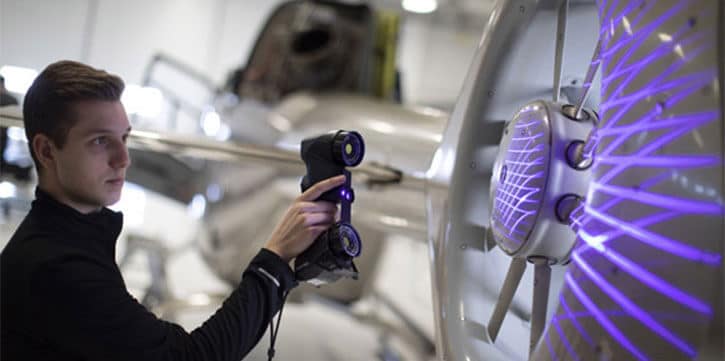
The measuring stays with you. We have our own scanners in Hanoi and know scanning well, but for an international lab, scanning at or near the lab is faster and cheaper than shipping parts to Hanoi and back. The one exception is a large batch of parts that does not need to be returned. Otherwise, measuring is what you do best — and it is why the customer came to you in the first place.
What a Lab Can Sell Once the CAD Half Is Covered
1. Parts with no drawings. An old machine, a supplier that has closed, design data that has gone missing. The customer has the physical part and needs a file to make it again. This is the most common job of all.
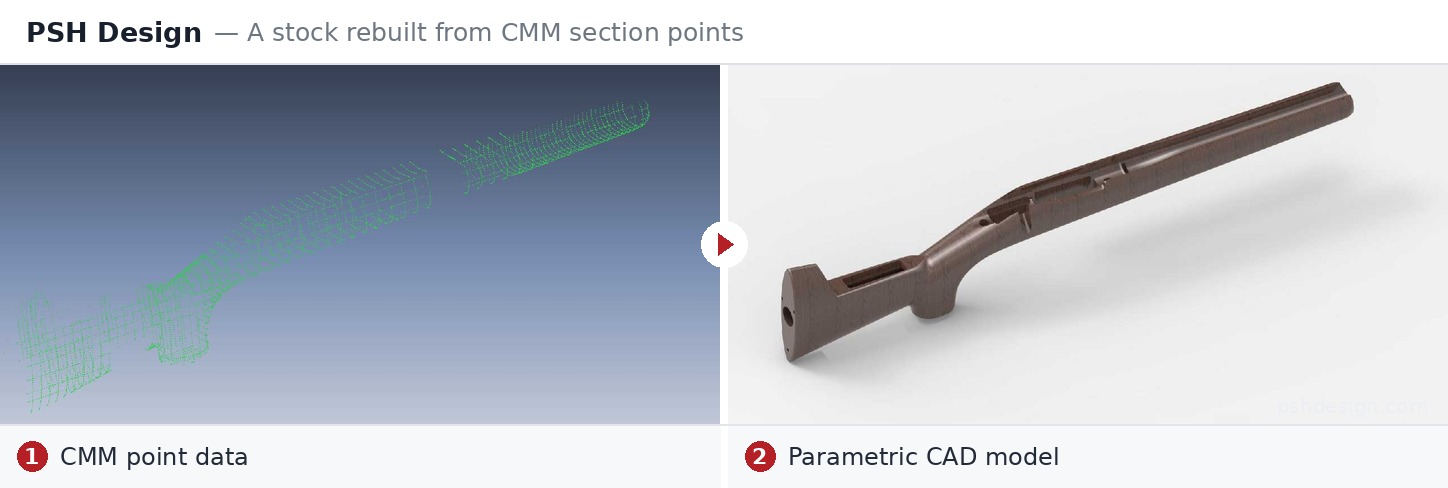
2. CAD from CMM data the lab has already measured. Many labs have years of CMM reports in their archive, and every one of them is a potential CAD model. CMM points alone — with no scan — are enough for us to build a full parametric model, as long as the sections cover the features that matter. For the customer, it is a new service built on data they have already paid to have measured.
3. Moulds, fixtures and design changes. The customer needs tooling for a part that already exists, or needs one dimension changed before the part is made again. That takes a model that can be edited, not a scan mesh.
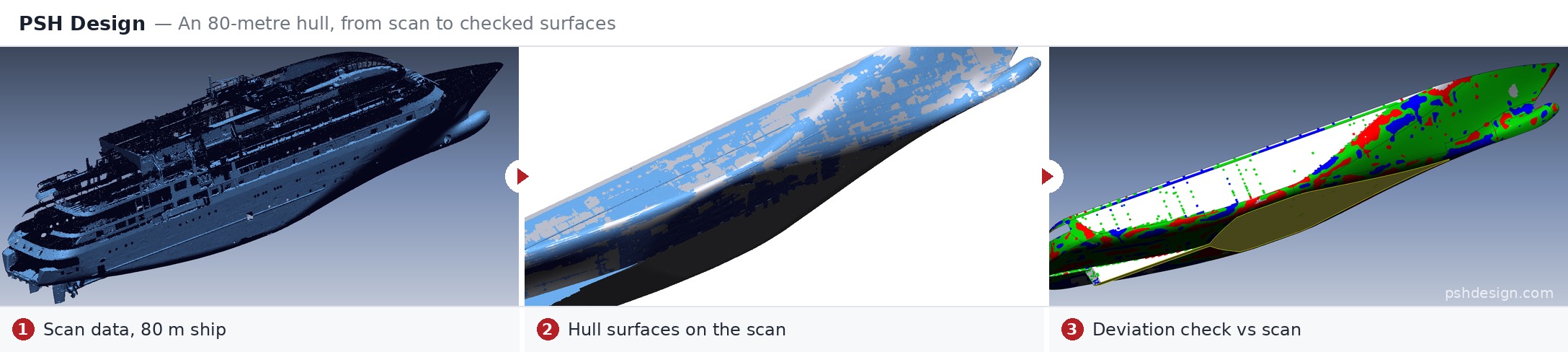
4. Proof that the model matches the part. Every model we deliver comes with a deviation report against the source scan or CMM data. The lab hands over not just a CAD file but evidence that the file matches the real part — the kind of record customers working under a quality system always ask for.
The range is wide: parts a few millimetres long, gears, moulds, aerospace components, heavy machinery, a complete helicopter, a 10-metre aircraft and the hull of an 80-metre ship.
Why the Hard Part Is the Person, Not the Software
We work in Geomagic Design X, PolyWorks and QUICKSURFACE, and deliver native in SolidWorks, Creo, CATIA, NX, Inventor, Solid Edge, AutoCAD and Revit. Any lab can buy the same software. What it cannot buy with the licence is the judgement of the person using it.
When a model is converted automatically from reverse-engineering software into CAD, small errors between faces often stay hidden. The deviation check passes; the problem appears only when the end customer rebuilds a fillet, adds a feature or cuts a mould. For a lab, that is the worst place for an error to surface — at the customer, under the lab’s name.
Avoiding it takes one engineer who knows the reverse-engineering software, the target CAD system and surface modelling well enough to rebuild the part the way its original designer would have. Why that is, and why not every studio can deliver true native files, is explained in our guide to CAD file formats.
Accuracy That Matches the Purpose
A parametric model is rebuilt to design intent — nominal dimensions, true planes, concentric holes — and typically sits within about 0.1 mm of the scan. A NURBS as-built model follows the part to about 0.025 mm, down to 0.01 mm on a clean scan. The parametric figure is larger on purpose: copying wear and distortion with great precision only builds the defects into the next batch, and for most industrial parts, matching a scan far below ±0.1 mm is useful only for comparing wear. How to read a deviation figure is covered in Scan Data to CAD.
How a Job Runs, Step by Step
- You send the data — an STL mesh (the format we receive most often), a point cloud or a CMM point file, with photos of the part if you have them. In most cases the files sit in the cloud storage you choose, and we work from there. The full list of formats is in our guide to CAD file formats.
- If the scan is poor, send it anyway. Gaps, noise, misaligned shots — we assess the data and tell you what we can do with it. In many cases experience covers what the scan does not.
- We ask four things before quoting — the units, the coordinate system and datums, which faces are functional, and which CAD system the end customer runs.
- You get a quote within 24 hours, per part. The price depends on the output the customer needs and on how difficult and complex the part is, so we look at the data before we price it. (what decides the hours and the price)
- We build the model. The time difference works for you: send the files at the end of your day and there is progress by the next morning.
- We check it against the source data and write the deviation report.
- We deliver under your name — native, STEP, and 2D drawings made to your drafting standard.
- The work is warranted for life. If something we built turns out to be wrong, we fix it at no charge, however long ago we delivered it.
Typical design time — working hours, not calendar days:
| Part | Typical design time |
|---|---|
| A gear | 12 hours |
| A machined part | ~16 hours |
| A mid-size casting | 16 hours |
| A mould set | 48 hours |
Across the whole workload the average is about 10 hours per part. The studio has 12 experienced engineers and can take on around 10 parts a day, so a lab that lands a large order does not have to turn it down or stretch the delivery date. Because of the time difference, most of those hours run while your lab is closed.
What It Costs Compared With Hiring
Our rate works out at about 70% of what a lab would pay for a CAD designer of its own — and that comparison leaves out the three to five years it takes to train one for this work, and the licences for at least two CAD systems that have to be paid all year for work that arrives in bursts. The full cost of building the capability in-house is set out in What CAD In-House Costs.
| Minimum order | None — one part is a job |
| Volume | Discounts for large quantities |
| Invoicing | One invoice at the end of each month for all work completed that month |
| Payment | NET 30 from the invoice date |
| New design work | Changes the customer asks for after delivery are quoted as new work; errors in what we built are fixed free, for life |
Terms That Protect the Lab
| NDA | Signed before any file arrives, covering the incoming measurement data and the resulting CAD; back to back with your customer’s agreement where yours requires it |
| White-label | No PSH name on files, drawings or reports. No contact with the end customer |
| Ownership | The models belong to the lab and the lab’s customer. Never used as portfolio material |
| Where the data lives | In most cases in the cloud storage the client specifies. A copy is kept on PSH storage only if the client allows it |
| Retention | Where we hold a copy, about five years by default, to support the warranty. Deleted at project close if your NDA or your customer’s policy requires it |
| Warranty | Every model is warranted for life |
| First part | Built at our cost, so the standard is established before commercial terms are |
One thing worth knowing: even when the data has been deleted on request, we can rebuild from the old scan data or from a new scan. The lifetime warranty does not depend on whether we still hold the files.
The Three Outputs Your Customers Will Ask For
Most disappointment in outsourced reverse engineering comes from ordering the wrong output, not from poor modelling.
| Output | What it is | Use it when |
|---|---|---|
| Parametric | A solid with a feature tree and editable dimensions | The customer will modify the design, machine it or build tooling |
| Hybrid | Parametric where the geometry is prismatic, NURBS surfaces where it is freeform | The part has both engineered faces and free-form surfaces |
| NURBS as-built | Surfaces that follow the real part closely, deformation included | Archiving, inspection, comparison with parts in service |
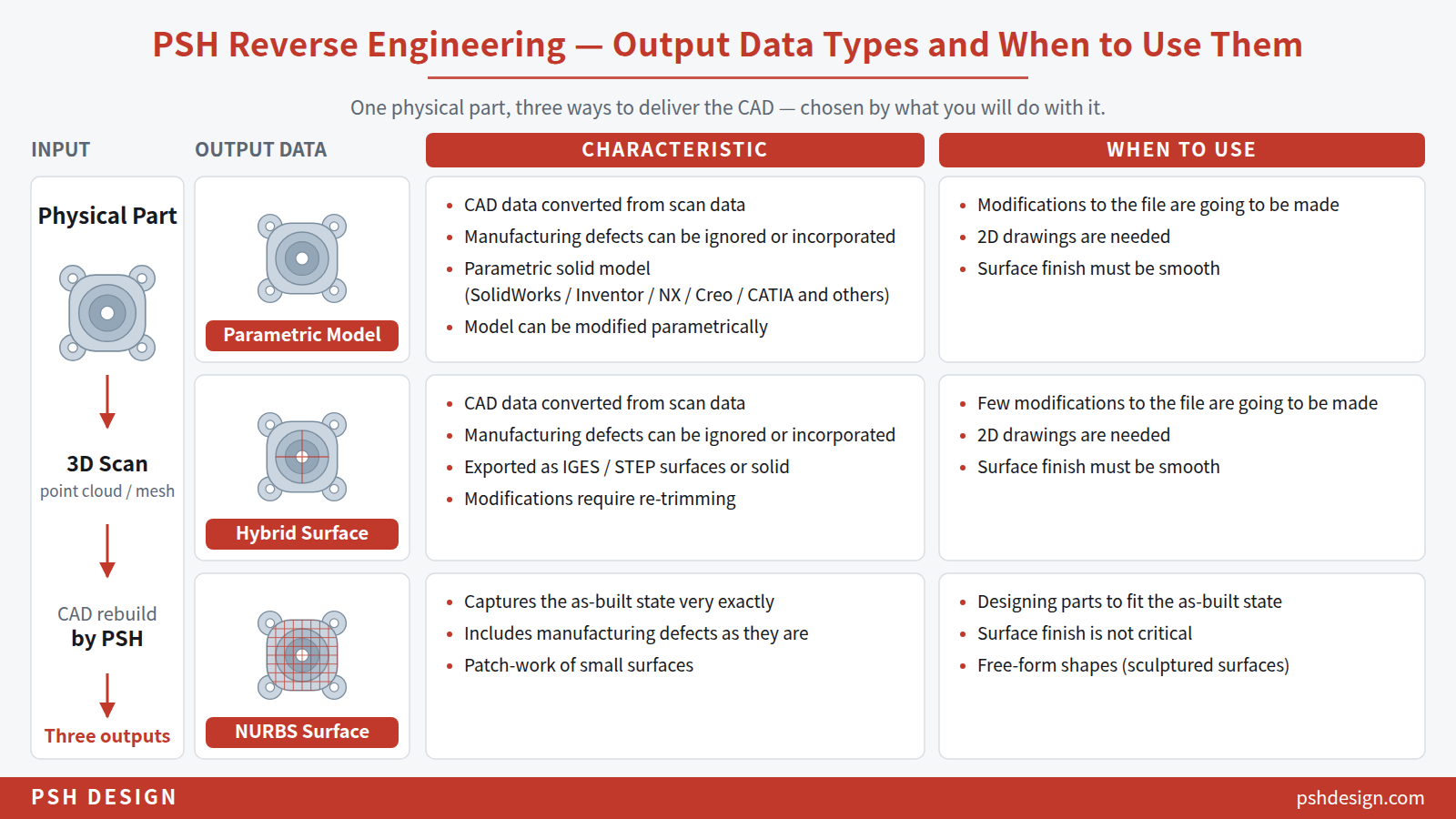
What each output carries, and the file formats that go with it, is set out in CAD File Formats: Which One to Send, and Which One to Ask For.
What We Turn Down
We do not take work that does not need an engineer: quick meshes for 3D printing, modelling from scans with no engineering intent behind it, one-off jobs run the way a freelancer would run them. We work with labs as long-term B2B partners — invoiced, warranted and accountable for what we deliver.
What It Looks Like After Ten Years
Two US metrology labs have worked with us continuously since 2014 and 2015. They measure, they keep their customers, they deliver under their own names. The CAD runs through us, and their customers receive one complete job from one place.
Beyond those two, we work with labs in the United States, Canada, Germany, Sweden, Austria and Australia. English has been our main working language since 2009, and we work in Japanese and German as well — so specifications, questions and reviews stay in the language the lab already uses.
Across the whole workload — roughly 300 parts a year since 2009 — no part has been returned to be rebuilt, and none has caused an error downstream, in a mould, a fixture or a machining setup. A model adjusted after delivery — a dimension the customer asks to add, a radius changed after a design revision — does not count as a failure; that is normal work on a model that is being used.
One job from that record, because it is exactly the situation this page is about:
An established inspection business won a component project that required more than measurement. We converted the CMM data to CAD geometry, ran the variance analysis against the original specification, brought the surfaces to aerospace-grade continuity and supplied the technical documentation. The inspection company delivered the whole scope under its own name, rather than referring the CAD work out.
Frequently Asked Questions
What does a reverse engineering partner do for an inspection lab?
A reverse engineering partner turns the lab’s scan or CMM data into native CAD and delivers it under the lab’s name, so the lab can sell CAD without hiring CAD engineers. PSH Design has worked this way for metrology labs since 2009, on roughly 300 parts a year.
How much does outsourcing reverse engineering cost compared with hiring a CAD engineer?
At PSH Design the rate works out at about 70% of what a lab would pay for its own CAD designer, before counting three to five years of training and licences for at least two CAD systems. There is no minimum order, and large volumes are discounted.
How quickly can a lab get a quote for reverse engineering a part?
Within 24 hours. PSH Design prices each part after looking at the data, because the output required and the complexity of the part drive the price; there is no fixed price list and no minimum order.
Can a reverse engineering partner handle a large order at short notice?
Yes. PSH Design has 12 experienced engineers and can take on around 10 parts a day, so a lab that wins a large order does not have to turn it down or stretch the delivery date. Large volumes are discounted.
Will my customer know that the CAD was outsourced?
No. PSH Design works white-label: files, 2D drawings and deviation reports carry the lab’s name and follow the lab’s drafting standard, and PSH Design never contacts the end customer or takes work from them.
Can we work with PSH Design in English?
Yes. English has been PSH Design’s main working language since 2009, and the team also works in Japanese and German. Labs in the United States, Canada, Germany, Sweden, Austria and Australia work with PSH Design day to day.
Where is our data kept when we outsource reverse engineering?
In most cases in cloud storage the lab chooses. PSH Design signs an NDA before any file arrives, keeps a copy on its own storage only with the client’s permission, and deletes it at project close if the NDA requires it.
What does the first job cost?
Nothing. PSH Design builds the first part for a new lab at its own cost, so the lab can judge the work before any commercial terms are agreed. After that, work is invoiced monthly, NET 30.
Questions about CMM data, poor scans, 2D drawing standards and the lifetime warranty are answered on the reverse engineering service page.
Start With One Part
Send one part — the kind your customers keep asking for and you have not yet taken on. We build it at our cost, deliver it under your name with a deviation report, and you judge the work before any terms are discussed. Send one part for a free pilot →
The full service — outputs, tolerances and formats — is on the reverse engineering service page.
Reverse engineering at PSH Design
Written for you if you run a metrology, CMM or 3D-scanning business — or an engineering team — and need scan or CMM data rebuilt as parametric CAD, delivered native in the system your customer works in. Not for you if you need a quick mesh for 3D printing, or modelling with no engineering intent behind it. We do not take that work, and saying so saves both sides time.
Read in this order:
- You Bought the Scanner. Who Builds the CAD? — what usable CAD means to the people downstream, and the two rebuild methods.
- What CAD In-House Costs, What a Day Costs, and What Actually Grows a Lab — software, training, lead time, and the number most quotes leave out.
- Reverse Engineering Services — formats, tolerances, lead times and terms.
Then judge the work, not the words: send one part — a scan, a CMM report or a drawing — and we build it at our cost →
PSH Design
17+ years of CAS, Class A Surfacing, CAD and Reverse Engineering for Automotive, Aerospace, Medical and Industrial, to OEM standard.
Concept Design & CAS · Class A Surfacing · CAD Engineering · Reverse Engineering
Work of this kind is easier to judge than to describe.