Alternatives to PSH Design: Six Ways to Get Scan-to-CAD Done, and When Each One Is Better
If you are looking for alternatives to PSH Design, you are doing the right thing. Nobody should hand a part to a studio on the other side of the world without first knowing what else they could have done with it.
This page is written by the company being compared. Read it knowing that. What it will not do is list five weak options and one strong one — the section on when PSH Design is the wrong choice is the longest one here, and it is specific enough to act on.
The Six Real Options
1. Build it in-house
Hire or train someone, buy the software, keep the capability.
The published list prices for a minimum toolset: Geomagic Design X Go from $1,900, QUICKSURFACE Pro at €1,700 per year, SOLIDWORKS Professional at $3,456 per year, Creo Design Essentials at $3,190 per user per year. PolyWorks|Modeler, CATIA and Siemens NX do not publish prices at all. Those figures sit in different currencies on different terms, so they do not add into one clean number, but one dedicated reverse engineering package plus two mainstream CAD seats is several thousand dollars a year before anyone has been trained.
Then the training. Learning to operate the software takes weeks. Learning to produce production-grade parametric CAD takes considerably longer — in PSH Design’s own experience, several years before someone works unsupervised on parts that go into tooling.
Right when: your volume is steady every week, the parts are confidential enough that they cannot leave the building, and you want the capability on your own balance sheet.
Where it breaks: lumpy volume. The licences are payable in full through every quiet month, and a trained modeler is someone every other company also wants to hire. The full arithmetic is in What CAD In-House Costs, What a Day Costs, and What Actually Grows a Lab.
2. The scanner vendor’s own service bureau
Most hardware manufacturers and their regional dealers will also build the model.
Right when: you bought the hardware from them, you want one supplier accountable for the whole chain, and the part is straightforward. They know their own file formats better than anyone.
Where it breaks: the business they are in is selling scanners. Modeling is a support function that helps close hardware deals, and it is staffed accordingly. The second issue is structural — a vendor who also sells to your competitors in the same region now knows which of your customers send you work.
3. A reverse engineering shop in your own country
Right when: the parts legally cannot leave the country, your customer’s contract requires a domestic supply chain, or you need someone physically on site with the part.
What it costs: Germany’s federal statistics office puts fully loaded manufacturing labor at €48.30 per hour worked (2024). In the United States, BLS median pay is $58,750 a year for machinists and $64,050 for tool and die makers (May 2025) — gross wages, not fully loaded, so the real employer cost is materially higher. A domestic engineering hour is not a cheap hour anywhere in Western Europe, North America or Japan.
Where it breaks: when it is the default rather than the decision. A good share of the parts people assume cannot leave the country have never actually been checked against the contract.
4. A large offshore engineering services firm
The thousand-engineer outsourcing houses in India, Eastern Europe and China.
Right when: you need hundreds of parts a month, a contractual SLA with penalties, a named account manager and a procurement process your own purchasing department recognises.
Where it breaks: at 10 to 40 parts a month you are a small account, and small accounts get the junior bench and a rotating cast. The senior people are on the contracts that pay for the building.
5. A freelancer on a marketplace
Right when: one part, not critical, nothing downstream depends on it, and the lowest price wins.
Where it breaks: continuity and recourse. Nobody carries the history of your parts from one job to the next, the person who did good work last quarter may be unavailable this quarter, and there is no warranty on a model that turns out to be wrong after the mold has been cut.
6. Another studio in Vietnam or Southeast Asia
PSH Design is not the only studio of this kind, and a competitor being cheaper or less busy is a real reason to use them.
What to ask them, the same questions worth asking PSH Design: who reads the RFQ — an engineer or a sales desk; what happens if a model turns out to be wrong in two years; whether a deviation report goes out with every model or only on request; and whether they will build the first part before being paid. The eight questions in full, with PSH Design’s own answers, are in How to Choose a Reverse Engineering Partner.
When PSH Design Is the Wrong Choice
These are not hedges. Each one is a case where PSH Design will tell you to use someone else, and several of them come up often enough that saying so first saves both sides a month.
- You need the scanning done. PSH Design does not scan. Scanning stays with you, and if you have no measurement capability you need a measurement company, not a design studio.
- The work is outside automotive bodies and interiors. No machine or plant design, no electrical, harness or control systems, no screen and software interfaces, no general mechanical CAD. PSH Design works on vehicle bodies and interiors, on the surfacing and engineering around them, and on medical device work that came out of the same skill — and nothing else.
- You want models built elsewhere corrected. PSH Design declines this work. It costs more than starting again and it ends badly for everyone.
- You need live screen-sharing through your working day. Hanoi is UTC+7 — 11 to 12 hours from the US East Coast, 14 to 15 from the West Coast, 5 to 6 from Central Europe. European customers overlap most of a morning. North American customers get an overnight turnaround instead of a conversation, and for some kinds of design work that is the wrong trade.
- You need a supplier holding ISO 27001 or TISAX today. PSH Design is working toward both and does not hold either at present. If your customer’s audit requires the certificate now, that is a hard stop.
- Your parts cannot legally leave your country. No arrangement fixes this.
- One part, cheapest possible, no second part coming. A freelancer will beat PSH Design on that job, and should.
When PSH Design Is the Right Answer
- A measurement or inspection company that wants the modeling delivered under its own name. The scanning stays with you, the client relationship stays with you, and PSH Design does not appear in the package that reaches your end customer.
- Volume that moves — 10 to 40 parts a month, not predictable enough to justify a salary and a licence stack.
- Native files rather than a STEP export: CATIA V5, Siemens NX, Creo, with the feature tree intact so your customer can edit it.
- Work where a deviation report has to go out with the model, because your customer wants evidence rather than an assurance.
- Parts that have to be right the first time because a mold, a fixture or a machining operation follows.
The Six Options Side by Side
| Option | Suits | Published cost signal | Where it breaks |
|---|---|---|---|
| In-house | Steady weekly volume, confidential parts | Several thousand dollars a year in licences, plus several years to competence | Quiet months; retention |
| Scanner vendor bureau | Straightforward parts, one accountable supplier | Quoted per job | Modeling is a support function; they also sell to your competitors |
| Domestic RE shop | Parts that cannot leave the country | €48.30/h fully loaded in German manufacturing; $58,750–$64,050 median US wages | Chosen by default rather than by requirement |
| Large offshore firm | Hundreds of parts a month, formal SLA | Negotiated, volume-tiered | Small accounts get the junior bench |
| Marketplace freelancer | One non-critical part | Lowest | No continuity, no warranty, no history of your parts |
| PSH Design | White-label scan-to-CAD, lumpy volume, native files | About 70% of what it costs to contract an equivalent designer; first part at PSH Design’s cost | No scanning; nothing outside automotive bodies, interiors and medical; no certificates yet |
How to Settle It Without Deciding
Comparing suppliers on a page is the weakest way to choose one. Every studio on every list claims accuracy, speed and experience, and none of those claims can be checked before the work exists.
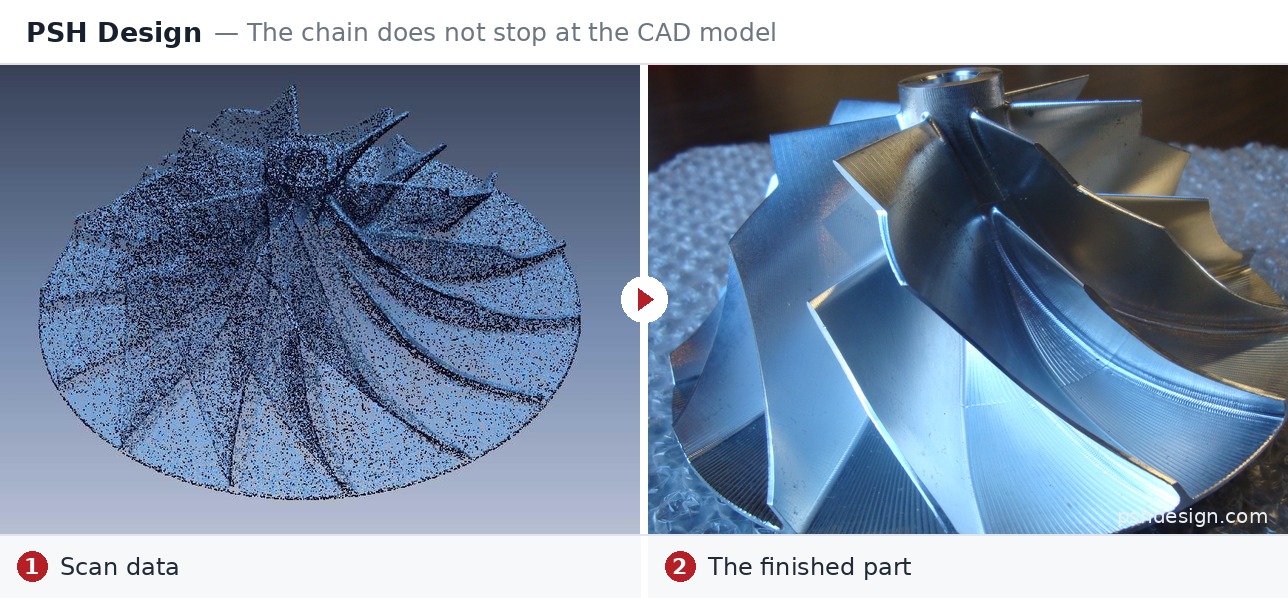
PSH Design builds the first part at its own cost. Send one part — a scan, a CMM report or a drawing — and judge the result against your own standards before any commercial conversation. If it does not measure up, the only thing lost is the time it took to send the file. About 70% of the companies that use that first free part go on to work with PSH Design long term, which also means roughly three in ten do not, and that is the honest shape of it.
The terms behind the first part: PSH Design quotes within 24 hours and a design engineer answers, not a sales desk. Normal lead time is two days for a mechanical part. Payment is NET 30 after the work is accepted. Every model is warranted for as long as you own it — if something turns out to be wrong this month or in five years, PSH Design corrects it at no charge.
Do the same with whichever two alternatives above fit your case. A supplier who will not build one part before being paid is telling you something about how confident they are.
About PSH Design
PSH Design is a CAD design studio in Hanoi, Vietnam, founded in 2009. It rebuilds around 300 parts a year from 3D scan, CMM data and drawings, roughly 3,000 hours, for measurement companies, Tier 1 suppliers and design studios in the United States, Germany, Japan and Australia. Alongside that it builds Class A surfaces, designs full-size automotive cubing and resolves concepts in CAS. Most of the work is delivered under the client’s name.
Full figures — hours by part type, tolerance bands and delivery formats — are on the reverse engineering service page. What three finished jobs actually looked like, with real hours, is in Three Reverse Engineering Jobs, Start to Finish.
PSH Design
17+ years of CAS, Class A Surfacing, CAD and Reverse Engineering for Automotive, Aerospace, Medical and Industrial, to OEM standard.
Concept Design & CAS · Class A Surfacing · CAD Engineering · Reverse Engineering
Work of this kind is easier to judge than to describe.