Hardware Startup Design: Why Product Surface Decides Trust
Why Most Hardware Startups Lose at the Surface
— and how the outside of your product decides whether anyone trusts the inside
A perspective for software-strong founders building their first physical product: a drone, a robot, an aircraft, a seaplane, or a piece of premium hardware.
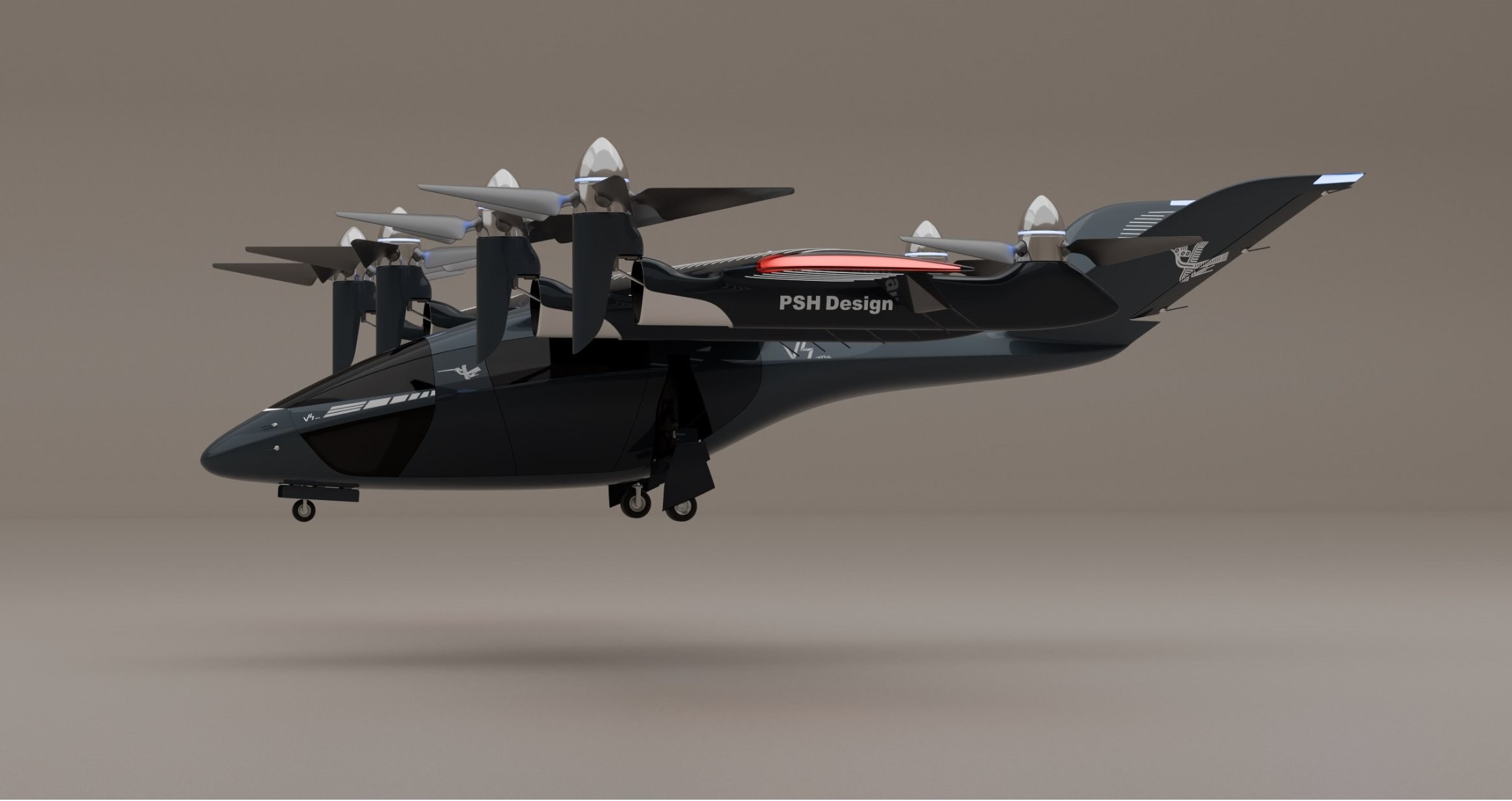
eVTOL concept — an internal project developed by PSH Design.
There is a hard truth most software-bred founders learn too late: in hardware, the first impression isn’t part of the battle — it is almost the whole battle.
In software you ship fast, ship ugly, then iterate; a clumsy early UI is forgivable because you fix it next week. That instinct got you here — and it is a trap the moment you’re holding a physical object, because a physical product has no “next-week update” for its shape. Once the mold is cut, the form is permanent.
And here is the part that stings: customers judge the quality of what they can’t see by the quality of what they can. If the shell looks cheap, they assume the core is cheap too — no matter that you have a quantum-grade marvel inside. You can win every engineering battle and still lose the war at the surface, before the customer ever switches it on.
This article isn’t about who to hire. It’s about what a sharp hardware founder needs to know about their product’s shell — the things most only learn after burning serious money on tooling.
The real pain: why software instincts betray you in hardware
Let’s name the traps a software-strong, hardware-light founder tends to fall into:
Trap 1 — “The shell is just the box my technology lives in.” Wrong. The shell is the product, in the only sense the customer experiences. They can’t touch your algorithm, your board, or the breakthrough technology you poured your heart into — the core inventions that often live inside as PCBs, test rigs, modules clipped together like Lego. None of that is something a customer can hold. They hold the shell. The feel in the hand, the tightness of the seams, the way light moves across the surface — that is the entire body of physical evidence they have about quality, before the product proves anything about the brilliant core within.
Trap 2 — “My mechanical engineer can do CAD, so the design is covered.” This is the most expensive misunderstanding of all. Engineering CAD (solid geometry, correct assembly, adequate strength) and Class A surfacing (seamless surfaces, flawless curvature continuity, clean reflections, a premium feel) are two different crafts. Your engineer does the first. The second is a separate, refined skill that very few people have. A surface that is “technically correct” can still look and feel cheap.
A quiet aside: the author started out as a mechanical engineer in a CAD role, so we’re allowed to joke about our own tribe. We like to say: if you let engineers run design unchecked, every car would end up boxy as a matchbox — it runs fine, but nobody turns to look. Funny, but true. Engineers optimize for what works; making an object that both works and makes people turn their heads takes a different eye entirely.
Trap 3 — “We’ll deal with it later, the core comes first.” The hardware cost curve punishes this delay brutally. Fixing a surface problem while it’s still digital data: nearly free. Fixing it after the mold is cut: tens of thousands of dollars and weeks of delay. But the deeper issue runs past cost: the shell and the core must grow together, not one after the other.
The common trap is to lock down the entire internal structure — board layout, battery, motors, sensors — and only then go looking for a way to “wrap” a shell around it. At that point the shell is just a coat thrown over a rigid block of geometry, and you have permanently lost the chance to build a product where form and function are one. The right way is the opposite: internal layout and external form language are developed in parallel from the very start — component placement considered alongside the exterior lines, so each serves the other instead of constraining it. A drone whose center of gravity and motor layout are worked out together with its aerodynamic shell will both fly better and look better — because the two were designed as one.
And remember: form is never just aesthetics. It is function (aerodynamics, ergonomics, thermal management, the feel in the hand), it is the aesthetic language the market expects, and above all it is brand identity — the signature that makes your product recognizable on sight and impossible to confuse with anyone else’s. Industrial design has to come in early, in step with engineering from the first sketches — not as a decorative layer glued on at the end.
Trap 4 — “Beauty is aesthetics, not engineering.” Dangerously wrong — and that’s the most interesting part, which we’ll get to next.
A demo-day scene you don’t want to repeat
You’ve raised your seed or Series A. The core team is all software, all sharp. The shell, you handed to a local machine shop — they built it, it fits, it works. Six months later it’s demo day in front of investors, or a pilot in front of a major customer. You switch it on; it runs flawlessly. But the first thing you hear isn’t about the technology — it’s someone murmuring: “it looks kind of cheap.”
In that moment, your excellent core has been betrayed by its shell. And fixing it now isn’t cheap: with the form frozen and the mold cut, every surface change is more weeks of waiting and a tooling bill big enough to make you wince. What would have been nearly free at the digital stage is now one of the most expensive line items of the quarter.
This isn’t a scare story. It’s a pattern that repeats with software-led hardware startups — and it is entirely avoidable, if the shell is taken seriously from the start. It’s also exactly why Trap 3 — “leave the shell for later” — is rarely just an aesthetic problem; it’s dead weight on your runway.
The cross-domain lesson: why surface is engineering, not just looks
Here’s the part few founders see. The principles that make a surface beautiful in one industry solve engineering problems in another. Four examples that map directly onto your product:
1. Automotive Class A surfacing → the aerodynamic shell of a drone or aircraft.
In automotive, a Class A surface isn’t just for looks — the seamlessness and continuous curvature of the body determine how air flows over it. For a flying vehicle this matters even more: a shell shaped with Class A discipline means smoother airflow, lower drag — which translates directly into longer flight time, lower noise, greater stability. The same surface discipline that makes a luxury car look flawless makes your aircraft fly farther and quieter. A beautiful surface and an efficient surface are the same surface.
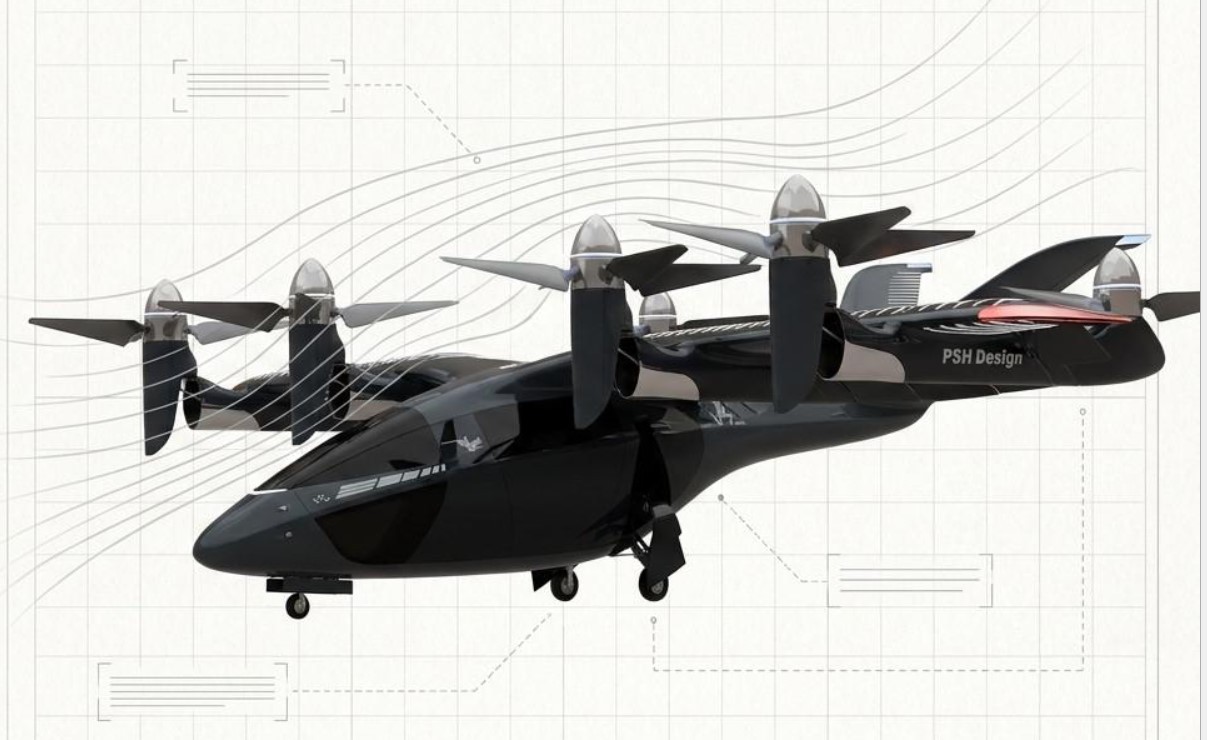
eVTOL concept with airflow study — an internal PSH Design project. Surface continuity and airflow are designed together, not separately.
2. Luxury car interior design → the cabin of a passenger aircraft.
Luxury automotive interior design is the art of making an enclosed space feel safe, calm, and trustworthy — through materials, proportion, acoustics, every touchpoint. The cabin of a passenger aircraft (eVTOL, seaplane, air taxi) faces exactly that challenge, multiplied: passengers are already anxious stepping into an entirely new kind of vehicle. The cabin has to reassure them — to speak of safety and trust before it ever leaves the ground. The discipline that makes you feel calm and pampered in a car carries straight over to making you trust an aircraft enough to step aboard. This is a psychological problem solved through design.
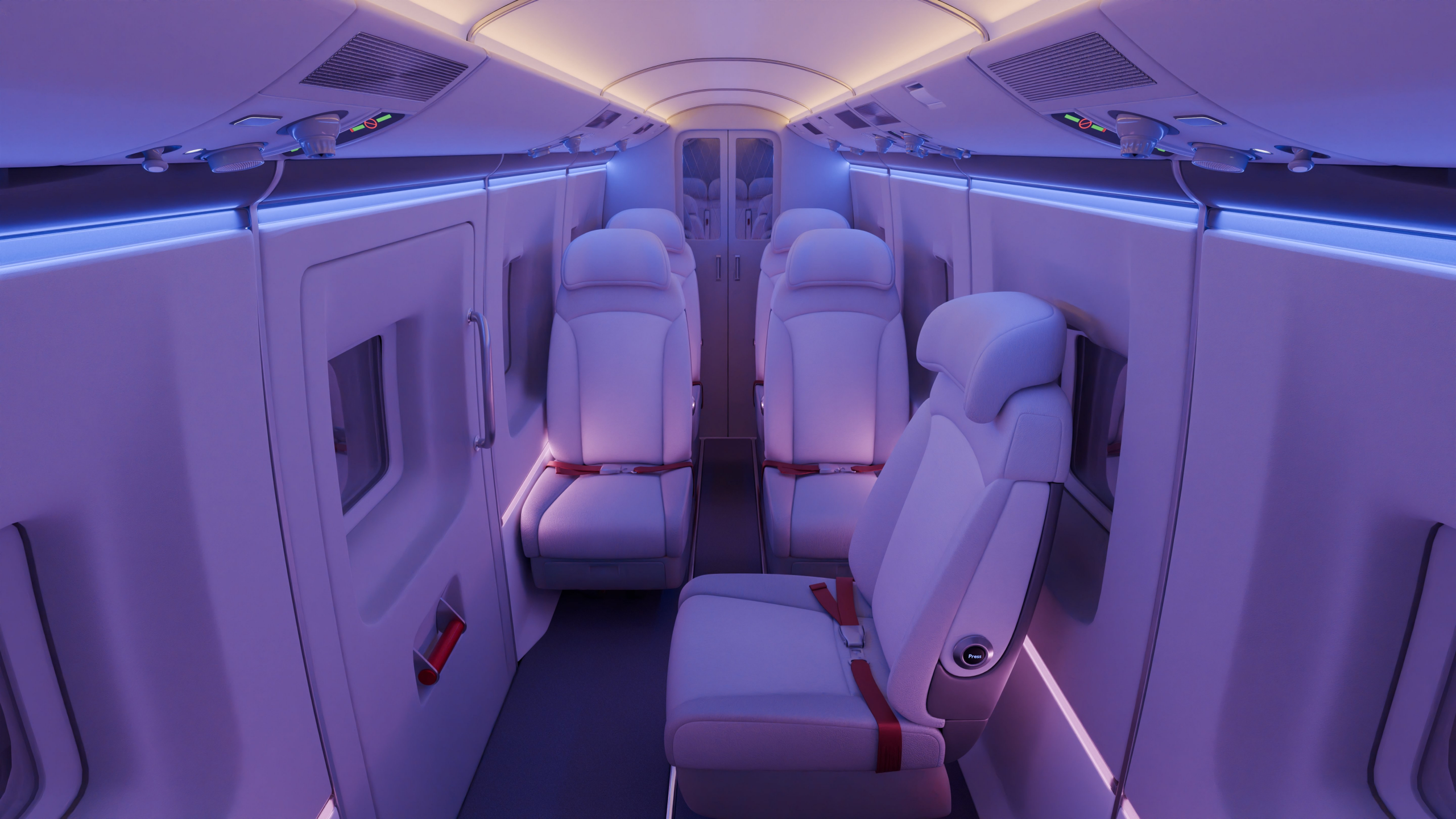
Aircraft cabin interior concept — an internal PSH Design project. Ambient lighting and proportion tuned to reassure the passenger.

The same concept under neutral light — surface quality, stitching, and seat detail show the high-end eye carried over from automotive interiors.
3. Premium surface quality → the line between high-end and everything else. What really separates a high-end appliance from a commodity one? Usually not the functional core — it’s the surface, the materials, the tightness of the seams, the tactile feedback when you touch it. “Premium feel” isn’t luck; it is designed, through surface quality and material choice (CMF). Customers register the difference in the first half-second of contact, even if they can’t name it. That is precisely what lets you price at a premium — or not.
4. The right surface and materials → longer life and a more sustainable product. This is a point European and Nordic markets care about especially, under ESG and circular-economy pressure. A surface and material choice (CMF) gotten right from the start lets a product endure 5–7 years of use without looking “worn out” — reducing replacement demand, extending the lifecycle. And a surface designed to be easy to disassemble and re-module isn’t just an aesthetic decision — it’s an engineering one that directly supports repairability and recycling. Beautiful design and sustainable design, once again, are the same problem.
What all four share: the shell works for you on multiple fronts at once — making the first impression, solving the engineering problem, and extending the product’s life. Ignore it and you forfeit all three.
We use aviation examples throughout this article not because PSH only does aircraft — but because aviation is where surface discipline is tested most ruthlessly, where every curve must be beautiful and obey aerodynamics and safety all at once. If a studio masters the surface there, most other products — drones, robots, appliances — become far easier. Aviation is proof of capability, not a limit on the field.
What to actually do with this
If you’re a founder building a physical product, here are the concrete moves:
Separate the two kinds of capability. Don’t assume your mechanical engineer covers premium surfacing. Ask directly: who on your team can do Class A surfacing? Here’s a simple test: if you can’t name a specific person responsible for the “feel” of the product’s surface — how it looks, how it feels to touch — that’s the sign you’re missing this capability. And it isn’t a minor aesthetic gap; it’s a gap in first impression, in pricing power, and sometimes in engineering performance.
Bring industrial design in early. Ideally in step with the first engineering drafts, before the form is frozen. The concrete trigger: as soon as you have the first 3D prototype of a first-of-its-kind design, and certainly before you send an RFQ to a mold maker. Every week of delay multiplies the cost of change once you reach tooling.
The overall silhouette is your signature. For an eVTOL or a drone, the silhouette is what customers — and investors — recognize from a distance, before they see any detail. A consistent, memorable form language is a real brand asset: it makes your product instantly identifiable and sets it apart from a sea of lookalikes. The exterior isn’t just a cover — it’s the face, the signature, the first statement of who you are.
Invest at the right level — not too much, not too little. You don’t need automotive tolerances on a household appliance. Demanding the top tier where it isn’t needed wastes money and time. But missing the refinement where customers can feel it is brand suicide. The art is knowing the right level for the right place.
A word for electric-aircraft startups
If you’re building an electric flying vehicle — eVTOL, electric seaplane, air taxi — everything above applies to you at the highest level. Aviation is where surface discipline reaches its ultimate value: here the surface is aesthetics, aerodynamics, and safety all at once. A millimeter wrong on the surface doesn’t just make the product worse — it changes how air flows, how it performs in flight, how much a passenger trusts it.
This is also why discipline forged in automotive transfers to aviation so naturally: both demand flawless surfaces from every angle, both are places where form must be beautiful and must function. The wave of electric-aircraft startups now rising — especially across the Nordics and the Middle East — is rich in aerospace and software engineers, but typically short on exactly one thing: the high-end surfacing eye to make their shells and cabins look like a trustworthy, billion-dollar product rather than a lab prototype.
If you’re on an eVTOL, electric seaplane, or next-generation flying-vehicle project, you live in a world where every body curve touches certification, drag, noise, and passenger trust. That is exactly why we devote most of our internal concepts to aviation — to train surface discipline where there is no margin for error. And once mastered there, we bring that same discipline down to every other physical product.
PSH Design — when you need exactly that gap filled
Everything above, you can do yourself — if your team already has the surfacing and industrial-design capability. The rest of this article is only for those who, having read this far, recognize that this is precisely their current gap. If you see that your team is missing exactly this capability — premium surfacing, cross-domain design thinking, the eye that separates high-end from the rest — then a partner like PSH is worth a try.
We are a high-end surfacing and industrial-design studio, 17+ years forged against the most demanding requirements in design — on projects for top-10 global automakers, where a millimeter of surface error is not allowed. Our strength is cross-domain range: the same surface discipline from a luxury car body transfers to the aerodynamic shell of a flying vehicle; luxury interior experience to an aircraft cabin; the high-end eye to premium appliances. We don’t bring automotive tolerances you don’t need — we bring the eye and the discipline forged at that level, applied at exactly the level your product needs.
Below is an electric-seaplane concept developed in-house by PSH Design — shown half as wireframe, half as finished render. The wireframe is a CAS-stage model (Concept / Computer-Aided Styling), the initial form-defining step. The mesh is built clean, evenly divided, and deliberately laid out so the shape is right from the very start — a foundation good enough to build up and finish into the Class A-ready surface you see on the right. It is the shape at this CAS stage that decides everything downstream: get it right here and the path to Class A is smooth; get it wrong here and no amount of surfacing can save it.
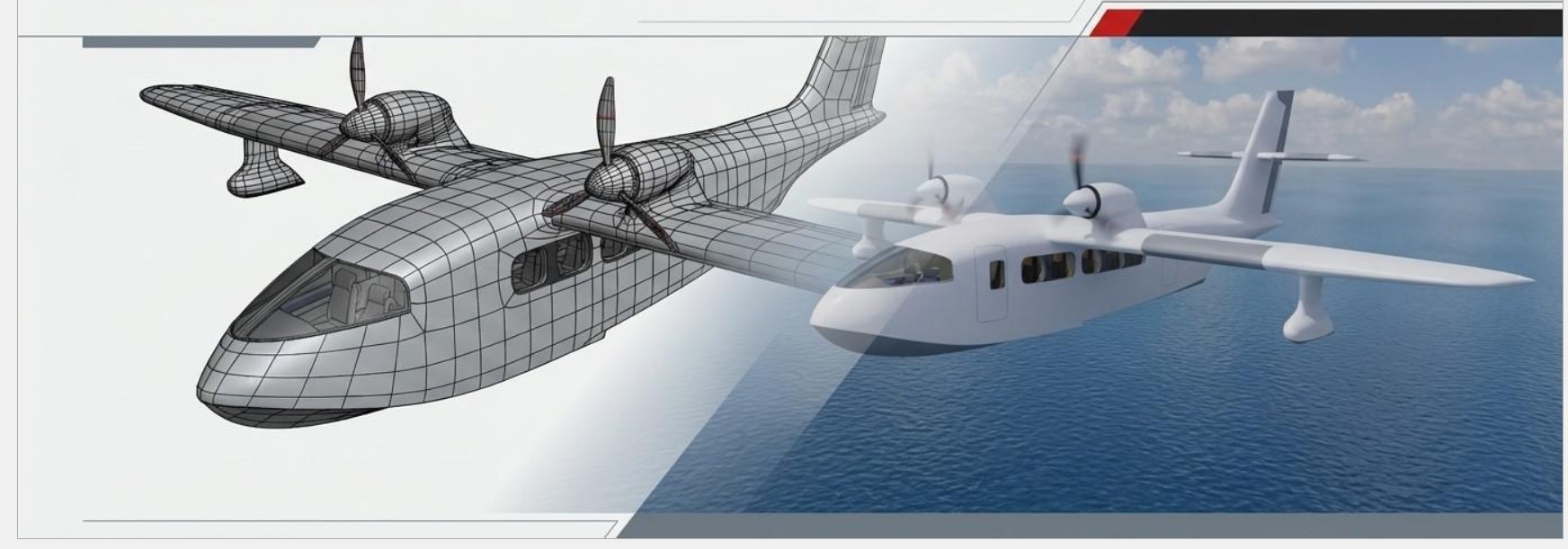
Left: the CAS-stage surface mesh. Right: the same concept finished into a clean, Class A-ready surface. PSH Design internal concept.
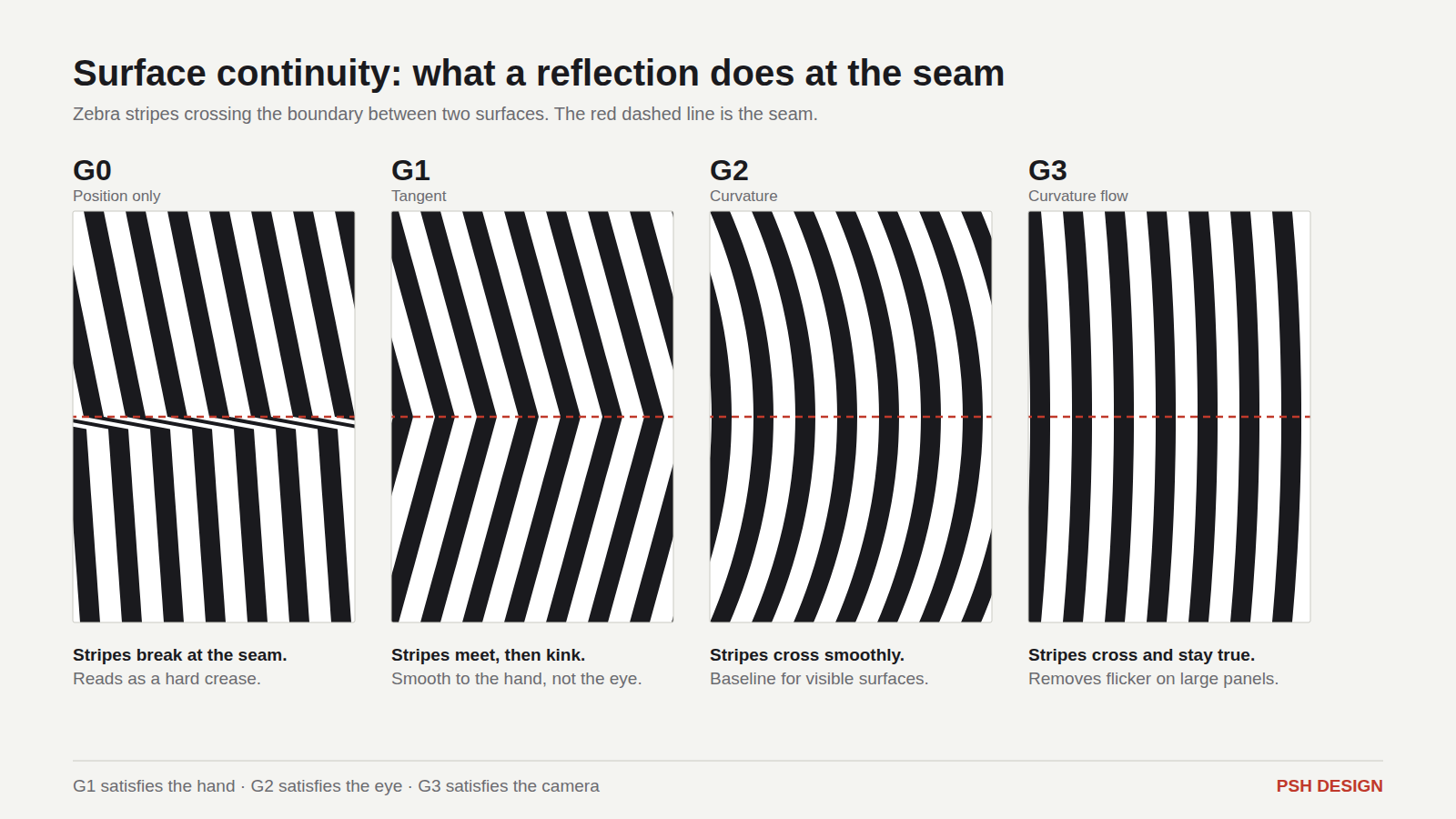
For an engineering leader evaluating any surface work — in-house or outsourced, and especially when you consider an external surfacing partner — a few concrete checks go a long way: curvature plots that stay smooth across patch boundaries, reflection lines that flow without kinks, and G2 continuity at the junctions that matter. You don’t have to be a surfacing specialist to ask for these — you just have to insist they exist. If a vendor can’t show you clean curvature and reflection analysis, that already tells you most of what you need to know. And it’s not abstract: the same discipline behind those smooth curvature plots is exactly what keeps your shell from becoming the “it looks cheap” moment at demo day.
We work remote-first, collaborating across US and European time zones, with weekly reviews and fast iteration. We make design decisions with you, but final control always stays yours — and we’re honest about scope: we excel at the shell, the surface, and industrial design, working alongside your engineering team, not replacing it. The ideal point to step in is before you send an RFQ to a mold maker — exactly when every change is still cheap. Coming in that early often saves you a full round of mold rework: from an investor’s point of view, that’s weeks of runway not burned for nothing.
On deliverables, we fit your pipeline rather than the other way around: we can provide virtually any CAD format your team requests. Native files in Alias, CATIA, or NX where you want them — and neutral STEP or IGES for surface exchange. For aviation, where CATIA and NX native data is what your downstream teams value most, we deliver exactly that — so your engineers can take the surfaces straight into structural, CFD, or manufacturing workflows without a messy translation step.
The next step: a small, low-risk pilot
Send us a short pitch deck, a CAD/Figma file, or just a few photos of your current product. Within 48 hours, you get back a short visual assessment — pointing out the surface- and form-level risks, plus where we see the biggest opportunity to make a difference. No strings attached; afterward you’re entirely free to continue with your in-house team or current vendor. If it feels right, we begin with a tight pilot on a single key element — one shell, one cabin, one critical surface — so you see real results before committing to anything bigger.
Whether you’re building an aircraft, a drone, a robot, or a high-end appliance, this pilot is designed to slot in right where you stand — for any physical product that needs a surface that earns trust at first touch.
And if you’re a CTO or head of hardware, you can treat the 48-hour pilot as an external surfacing review of your current design — a second set of eyes focused only on the surface, before you commit it to tooling. Think of it as a code review, but for the shape.
PSH Design — high-end surfacing and industrial design. 17+ years forged for top-10 global automakers. Remote-first, working across US and European time zones. Now built for the next generation of hardware unicorns — and the next one might just be yours.
Referent more :
Sub‑D Modeling + AI: The Emerging Workflow Reshaping Automotive Interior Concept Design
Elegant Simplicity: The Class A Surfacing Precision Behind Modernist Design Language
3D Reverse Engineering & AI Design: The Future Foundation of Medical Device Innovation
Scaling Inspection Services with a Comprehensive Reverse Engineering Partner
PSH Design
17+ years of CAS, Class A Surfacing, CAD and Reverse Engineering for Automotive, Aerospace, Medical and Industrial, to OEM standard.
Concept Design & CAS · Class A Surfacing · CAD Engineering · Reverse Engineering
Work of this kind is easier to judge than to describe.